A paradox is an opening, not a problem to resolve
A conversation with Thai filmmaker Tulapop Saenjaroen on the entanglement of labor, leisure, and corporate aesthetics, and how his moving-image practice destabilizes institutional rhetoric, using vulnerability and formal contradiction to uncover the lived experiences that still evade market logic.
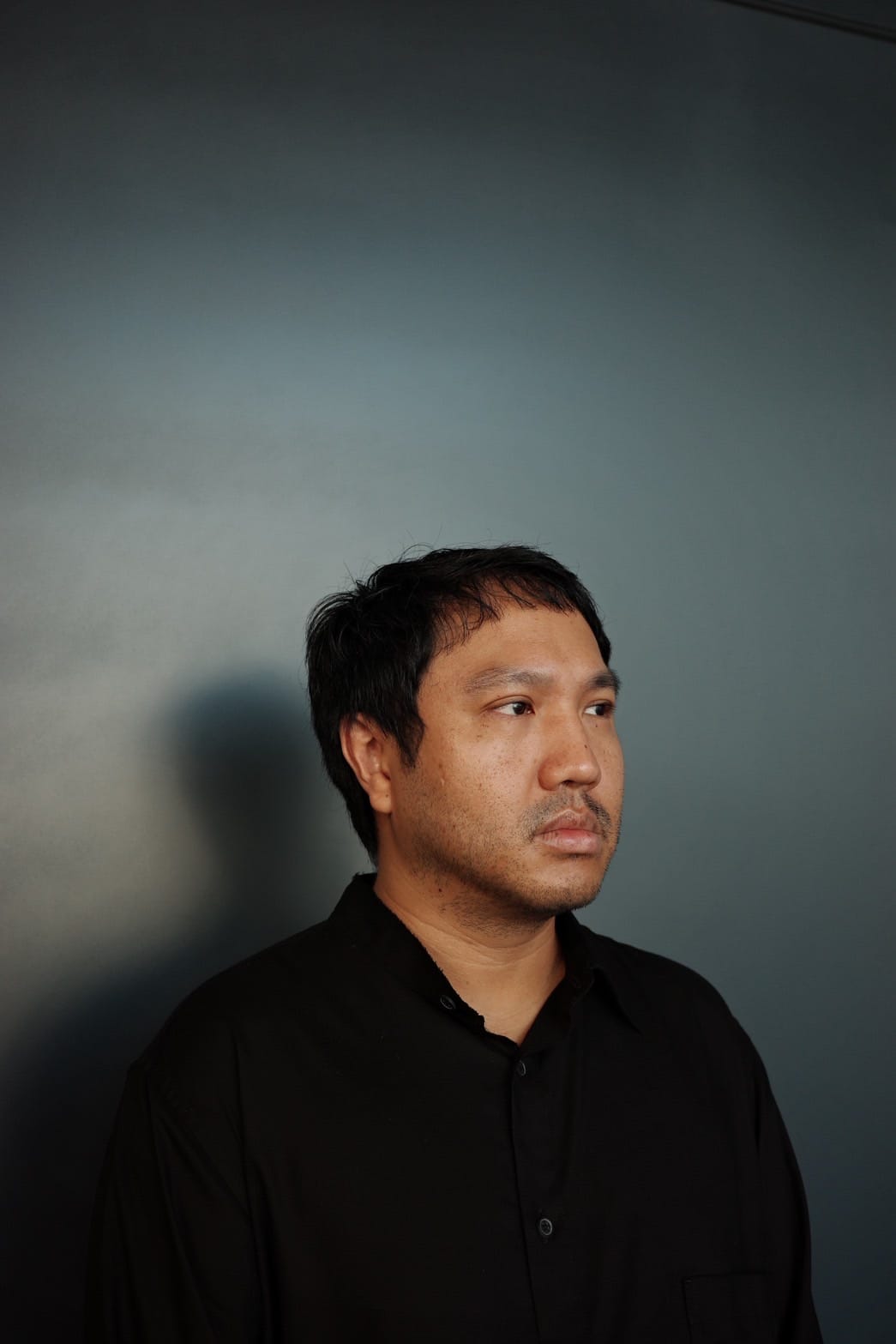
Tulapop Saenjaroen was born in Chon Buri, a coastal province whose economic geography is defined by export automotive manufacturing and resort tourism occupying the same shoreline. It is a conjunction of realities that finds a certain echo in his artistic preoccupations with the institutional management of bodies, the commodification of rest, and the productive nature of leisure.
Saenjaroen holds an MFA in Fine Art Media from the Slade School of Fine Art, University College London, and an MA in Aesthetics and Politics from the California Institute of the Arts. He currently lives and works in Bangkok. Since 2009, he has been part of the production company Electric Eel Films, founded by filmmaker Anocha Suwichakornpong, with whom he has maintained a close creative collaboration. His work has been screened at international film festivals including Locarno, Rotterdam, and Oberhausen, and at venues such as Tokyo's Image Forum and the Bangkok Art and Culture Centre. His practice has been the subject of focused retrospective programmes at the Gene Siskel Film Center in Chicago, M+ in Hong Kong, and the Korean Film Archive.
His practice moves across moving image media, video installation, and public intervention. An early instance of this approach is the performance Siamese Smile Contest, organized in 2010 at the JJ Market Creative Space within Bangkok's Chatuchak Weekend Market, in which participants competed to sustain a smile for as long as possible, with the winning duration reaching 172 minutes. The work takes a promotional concept from Thai state tourism campaigns and relocates it within the social heterogeneity of a public market. By turning a state-sanctioned image of happiness into a grueling feat of endurance, this early intervention established Saenjaroen's enduring focus on the biopolitics of labor and the deconstruction of ideological forms.
His most recent film, Local Sensations, premiered at Cinéma du Réel in Paris in March 2026, where it received the Short Film Award. Using this latest project as a point of departure, our conversation explores how formal strategies, from text and voiceover to material textures, become sites of political resistance across his work.
You grew up in Chonburi, where the Eastern Seaboard industrial zone and a tourist coast exist in immediate proximity. What was it like to grow up in a space defined by that specific geography, and did it shape how you think about the relationship between labor and leisure before any theoretical framework did?
It’s hard to say that I truly grew up there—I was born in Chon Buri but my relationship with the place has always been a bit inappropriate, I was neither local nor tourist. I started studying in Bangkok when I was five, and every weekend I would go back to visit our family house because we’ve been running some kind of leisure business there. I think that confusion of being both insider and outsider, plus ‘leisure’ and ‘business’ already combined as the background of my childhood—those two things somehow shaped how I see. That paradox unconsciously shaped my way of seeing, and I guess it still does today.
I want to ask about the encounters in the past or even now, be it art of any form or theoretical texts, that expanded your sense of what art could do and made you feel artistic practice could be an instrument for thinking about and intervening in the world.
I think what expands my sense of what art can do is courage — something cumulative and relational, rather than coming from a single piece of work. Seeing it in filmmaker and artist friends, or sometimes in complete strangers, always pushes my thinking and questioning about what practice can be and what its potentialities are. I try to look for that courage in different forms, as mindfully as I can, even in the smallest things. And I find it's always somewhere — in any kind of making, especially when I'm lonely, circling inside my own head. This might sound naïve, but I have doubts about the idea of a solo changer.
I also think that spending time with my dog and listening to music open up thoughts. Connecting the world that is outside or irrelevant to art is necessary.
You studied in Chicago, Valencia, and London. Returning to make work in Thailand, particularly work that engages directly with its political history, involves a specific set of material and institutional constraints that those contexts most probably do not prepare you for, such as what can be said publicly, what can be funded, what audiences exist for this kind of work, and what the consequences of certain formal or political choices might be. How has navigating those conditions shaped the work, and are there things the films do or avoid doing that are direct responses to the specificity of that context?
It's really difficult to pin down what I specifically intend to do or avoid — for me those two things are inseparable, even interchangeable or conflated sometimes, especially when it comes to representing something. Include and exclude. I think I learned that from living in different environments as a teenager, and from that feeling of not belonging since childhood.
For many of the works I've made since returning to Thailand, I use struggle as a language. What matters to me is vulnerability — and I think that's also a kind of response to the constraints you're describing. When certain things are made unsayable, vulnerability becomes a persistent way of staying relevant—so it’s there but not there.
You have been working with Electric Eel Films since 2008, alongside Anocha Suwichakornpong. I want to ask about the practical and political dimensions of that structure. What does it make possible in terms of funding, production, and the kind of work that gets made, that working alone or within conventional industry structures would not allow? And what does it mean to build that kind of infrastructure for experimental and politically engaged filmmaking in Thailand specifically?
Courage, energy, exchange, friendship — I think those are the things that make other things possible. I personally find that filmmaking needs some kind of collective force. The thinking process can be lonely, but courage and support from companionship keep you from going astray. I think it’s fundamentally simple and indispensable.
You co-founded the Rapid Eye Movement screening series in Bangkok in 2022. I want to ask what that decision was a response to. What is the actual situation for experimental and essay cinema in Thailand right now, in terms of audiences, venues, critical writing, and the infrastructure for this kind of work to exist and be seen?
Rapid Eye Movement is no longer active, but at the time we wanted to add different flavors and shades to the existing spectrum. There were already other groups screening experimental and essay cinema — we just thought the more diverse the better.
As for the broader infrastructure in Thailand for this kind of work — it's still inconsistent and unsustainable, in my opinion. But the screening community and audience have been growing a lot in recent years. The need for the alternative is becoming more and more ratified. Many people are contributing to the scene in their own way, and I find that rather hopeful.
You co-directed Nightfall with Anocha Suwichakornpong. The film places the speeches by Lee Kuan Yew and Thanom Kittikachorn praising each other's economic models at a 1973 state dinner against footage of her and Vel Ng moving through Singapore, through narrow passages and urban textures. What that combination produces for me is the distance between what political and economic agreements between states claim to be doing for populations, and what it feels like to be part of those populations. I want to know what the collaborative process felt like and what the film produced that you think neither of you could have made alone.
I couldn't make this film alone. The project grew from research Anocha did during an artist residency in Singapore. From some materials she gathered, we were exchanging ideas and constructing it together into a short film—it unraveled, expanded, and somehow found its own way. As I briefly remember, it was like ten years ago though, we talked about the speeches, and about how Thailand had once believed it would become the fifth tiger of the Southeast Asian region. We arrived at something mirroring—something anachronistic, between past and present, shared but separated. I learned a great deal collaborating with her.
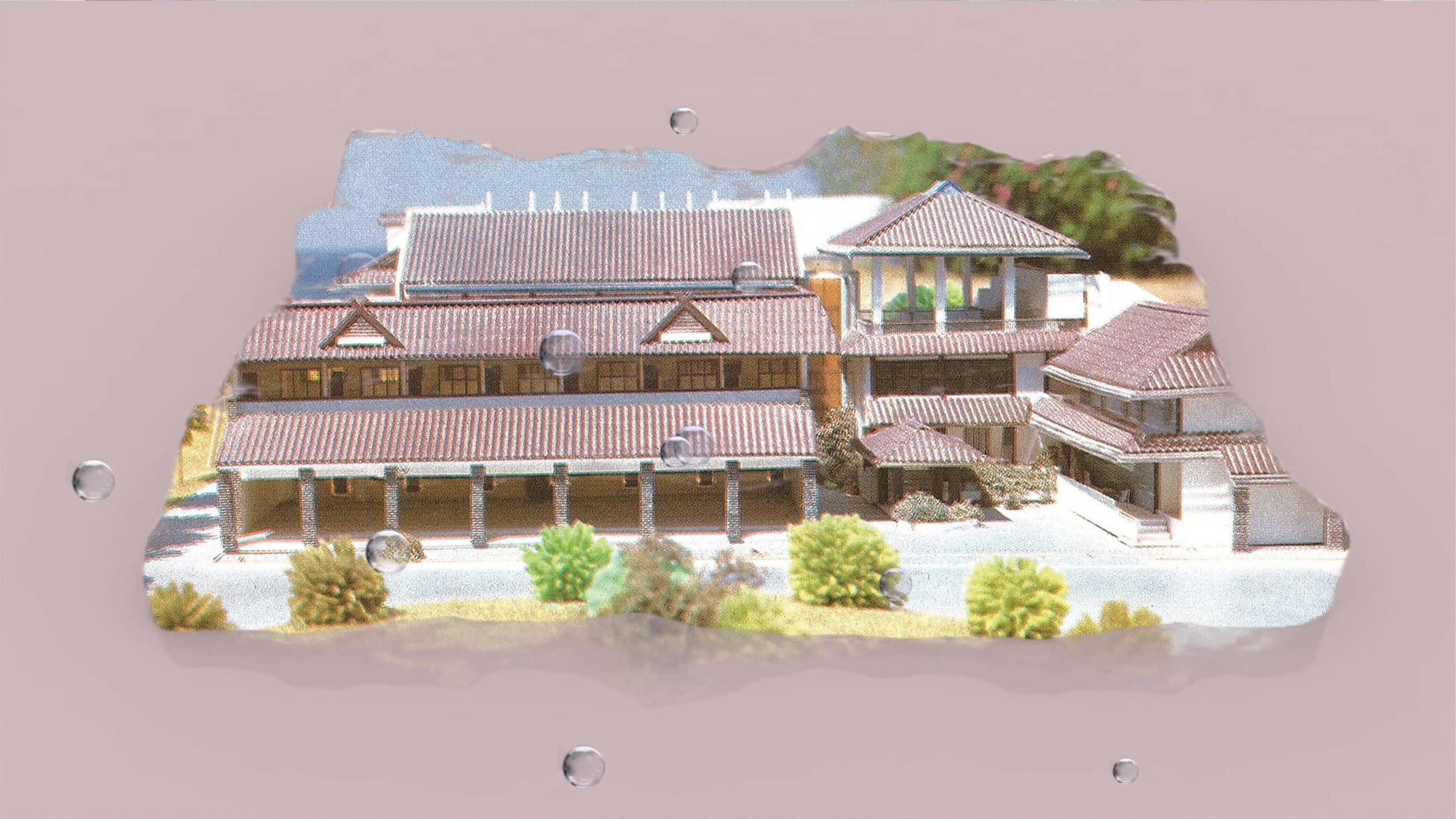
Local Sensations is the first film in your practice shot on 16mm black and white. I want to ask what the physicality of that format gave you in the editing room that you could not find elsewhere, and why a film dealing with the strict and rigid rules of architecture required that unpredictable material texture.
I try not to think too much about the meaning of film as a medium — I think meanings can fluctuate. But I do feel that the filmic look, when transferred to digital, creates a confusing and ambiguous space, bordering profound and profanity somehow, and for this film I needed that. I wanted room for improvisation with an unfamiliar medium. I wanted control to become almost incidental during the shooting process — with digital I tend to shoot endlessly, so limiting myself to film, especially on a limited budget, forced a different kind of attention and grounding.
But distance in the making is also really important to me, for this film and its subject. I wanted to distance myself—a distant re-positioning, not anything like discreet disavowal— to observe other collaborators: the cinematographer, the film developer, the scanner, the colorist. All of those processes and the profilmic texture were, for me, indirectly co-writing the film.
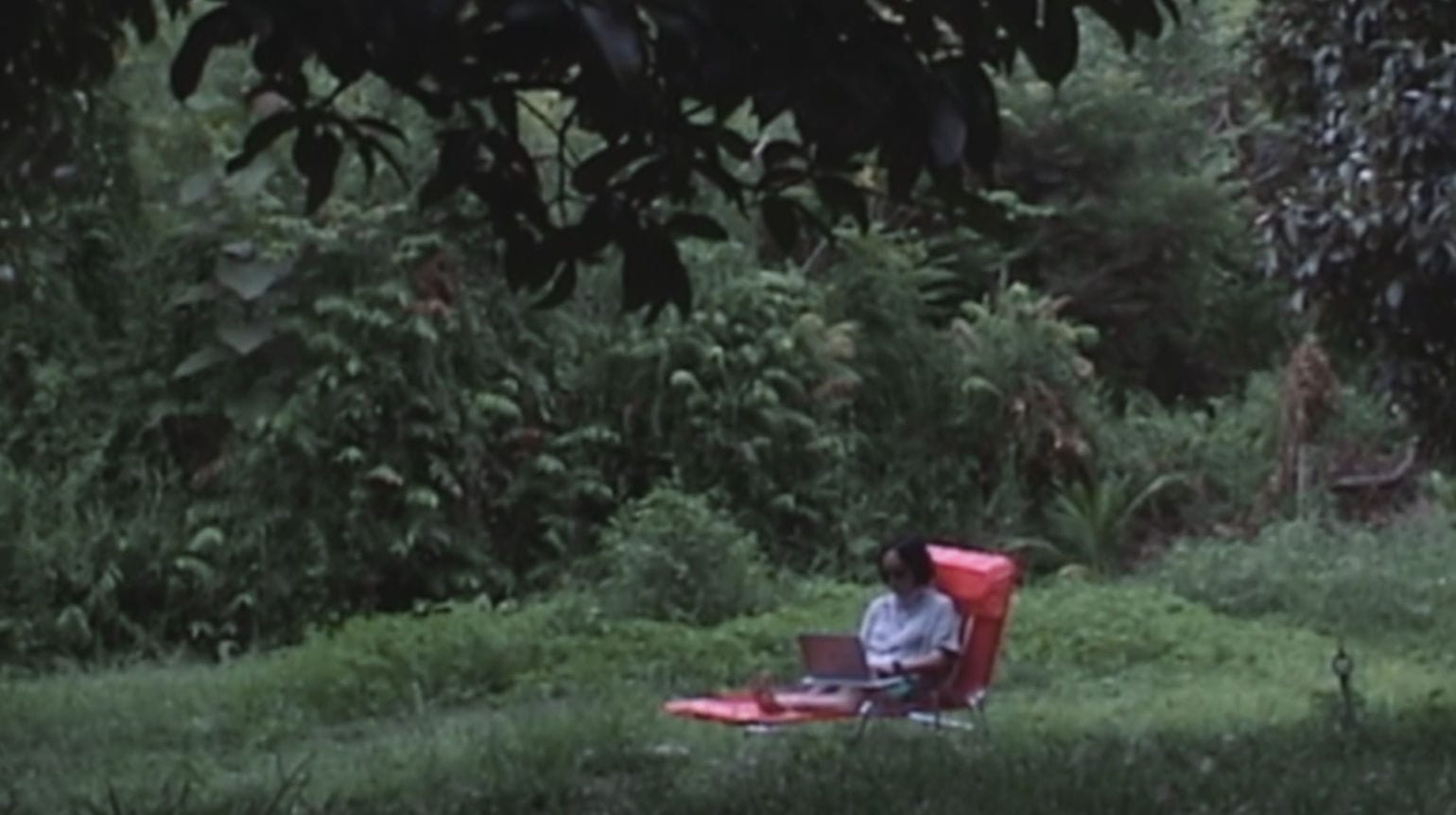
Across your films, the choice of format seems to carry the ideological associations of its previous uses: the Digital8 textures of Mangosteen carry the aesthetic of corporate training videos, the pixelated and layered imagery of Notes from the Periphery refuses the transparency that observational documentary would offer, and in Squish! the history of Thai state animation, used for anti-communist propaganda and village education alike, sits alongside wellness apps and exercise programs as versions of the same delivery mechanism. I want to ask about the process of choosing those specific formats. Do you begin with the format and let it determine the subject, or do you begin with the subject and find the format that already carries the right contamination?
As you said, each work explores a different set of aesthetics — sometimes they conform, sometimes they contrast, or even clash. I find it's very difficult to say which comes first, format or subject, because for me they're inseparable, convolutedly intertwined. What I'm really interested in is what lies between an existing aesthetic — most of the time tied to some kind of political agenda — and the process by which it accumulates connotations and meanings, how it becomes attached to certain readings. I'm interested in destabilizing that relationship to find a different way to look at something that already thinks it knows what it is, and opening it up for what it could possibly be.
Notes from the Periphery feels visually distinct from the rest of your work in a way I want to ask about. Your other films approach their subjects through specific mediating forms: the infomercial, the corporate video, the architectural-political manifesto delivered as liturgy. In Notes, the imagery of the port, the shipping containers, and the labor at the edge of Laem Chabang arrives through a different register entirely, and the film seems to be working through sound instead: the sci-fi oscillators and pulsing sinewaves remove the images from the present tense and place them in an uncertain temporal register. I know this film was originally a commission for the Abandon Normal Devices festival in the UK. I want to ask how the external parameters of that commission intersected with your personal history of Laem Chabang, and whether making a commissioned piece about a geography you grew up in required a different formal approach from the one you would have chosen independently.
The aesthetic register of Notes from the Periphery is different, I agree. I was interested in layers of moving and not moving — departure and stagnancy, links, breed, infection, inaccessibility, and ownerships. The sound and image take a different shape in each small part of the film. The sci-fi quality you mentioned was in the part of the port peripheral area where, to me, it was like an inaccessible empire (so many areas have no public access and we were being monitored and stopped during some point of the shooting) hence the sound and the image are designed not to go deeper but to spread around, contaminate, marinating-like.
I'm really grateful that the commission gave me a lot of trust and freedom. The process involved open conversation and embraced contingencies. To be honest, I never think about whether the film would be different without the commission — I'm always just trying to respond to the state I'm in at that particular moment. But I would say it would be a different film if made at a different time. It was during the pandemic, during the protests in Bangkok, when shipping containers were actually being used as a policing tool on the streets — and alongside that, the continuation of the Laem Chabang port's expansion into a new zone. All of that was present.
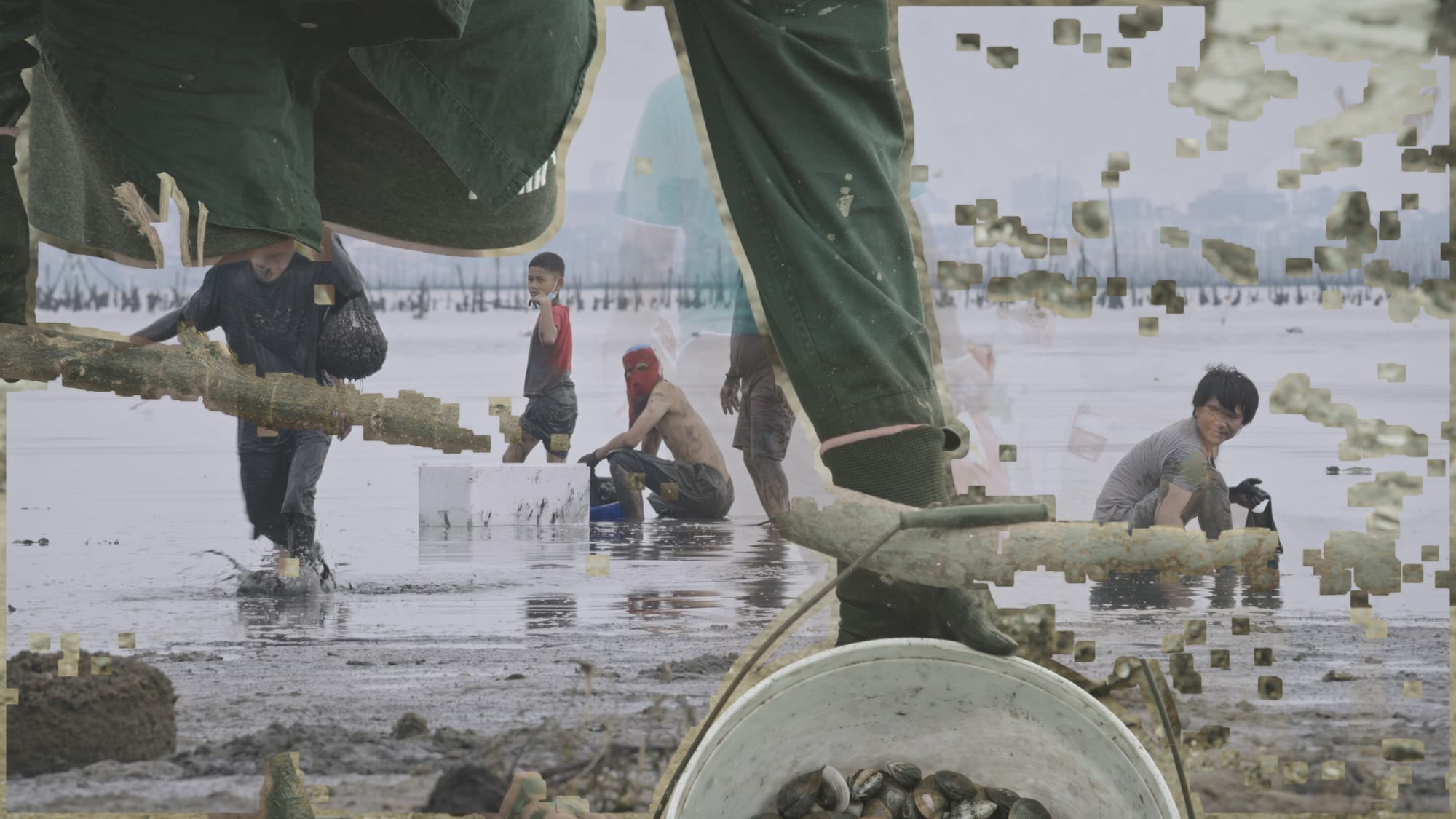
In Local Sensations, the title cards and subtitles often undermine the text they are supposed to mediate by being flipped upside down or blurring into translucence. I want to know what happens to the authority of a political text when it is subjected to this kind of visual instability, and what you think that instability does to the viewer's relationship with the argument the text is making.
I treated the text as a character in the film — as its own being, with its own agenda, interacting with other elements. It sometimes sanctifies, and sometimes is de-sanctified. When the subtitles flip or dissolve, I think what happens is that the authority of the text becomes unstable—subtitles are not only subtitles — and that instability creates a small gap for the viewer. A space to question rather than simply receive. And this goes back to what I was saying about the symbiosis of aesthetics and politics — form is never neutral, even when it appears to be serving something else.
You have described your voiceover characters as fictional people who only say what they want the audience to know, making everything unreliable. I want to ask what that unreliability does to the viewer specifically in films that are making arguments about ideology and power. How do you want an audience to engage with a political argument when the voice making that argument has already told them, by its own unreliability, that no frame can be fully trusted, including this one?
I like the moment of having an endless second-thought. The unreliable narrators are there to enact the same logic as the other components of the work — refusing to let ideology settle, revealing parts of an incomplete story, enabling reception to be not only passive but active. Again, I want to utilize the contradiction as an open gate.
Local Sensations utilizes a text that argues for democratization, but its form is a set of rules delivered with certainty about how people will behave in the presence of given architectural forms, which is its own kind of condescension. The text resists dictatorial control while practicing another form of control. I want to ask whether you see that contradiction as a problem the film is trying to work through, or as precisely the thing that made the text worth working with in the first place.
What I was trying to do with the film is neither to completely agree nor disagree with the text, nor to sever the relationship between control and freedom, nor to resolve any paradox. In an age where you can easily 'like' things on the internet, things become very reductive — but I want to spend time and listen to the microscopic details of things. With respect, I learned many things from the text — its legacy, and its willingness to resist the mental and physical violence that comes with sanctification from institutional and cultural structures in Thailand. For me, paradox is an opening, a passage toward other possibilities. An opening to irrelevant relevance. The text is also a character in the film. It coexists with other elements — they interact.
While preparing for this conversation, I read about the Siamese Smile Contest, where participants competed to hold a smile for as long as possible in a public market as a commentary on the state policy of Thailand as a land of smiles. I saw in that description the compressed form of something that runs through your entire subsequent practice, the performance of an affective or emotional state as competitive labor, the smile that was supposed to be natural becoming visibly and uncomfortably a job, but also a state imposition and a form of biopolitics. A character in People on Sunday echoes this physical strain when she says she no longer knows what a natural state feels like in her actual life. Looking back now, after fifteen years of work examining very similar territory, how has your relationship to that early performance evolved? How do you view that initial question now that you have spent over a decade dissecting the natural body on film?
You're right — its spirit still lingers here somehow. There are many things I forget along the way, but I could say that the question has expanded vertically and horizontally — more abstract, but reaching out to more contexts that still share certain reflections. I've become more and more interested in the image body as a physical body, a body that is not a mere representation, whether in cinema or in real life. 'Dissect' is an interesting word you use. With the performance at that time I was probably examining muscles and bones — but now I'm exploring blood and liquids, metamorphically.
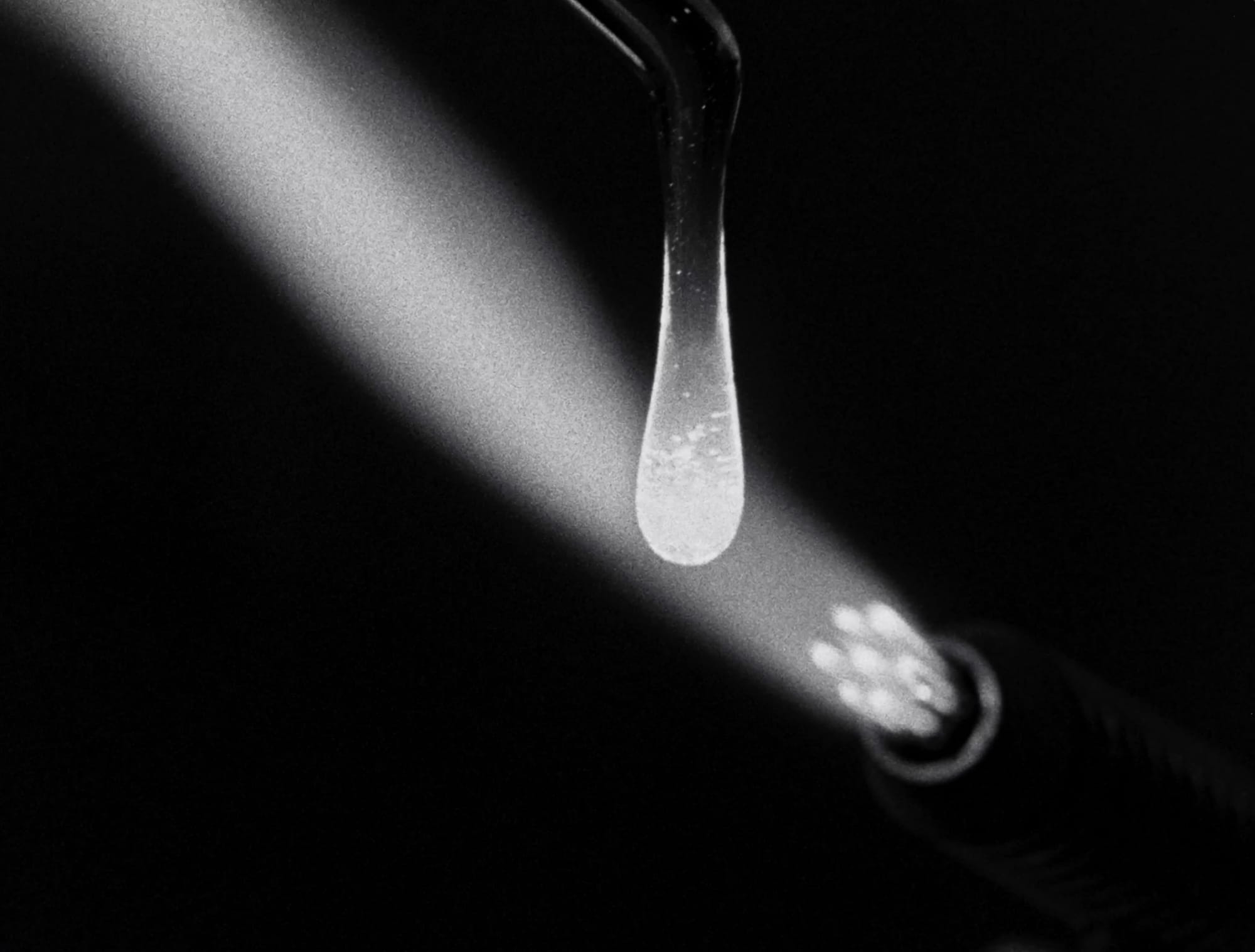
Local Sensations places unpredictable physical crafts, like improvised music and glassblowing, directly alongside completely artificial environments like the indoor snow town. I find myself reading this juxtaposition as a suggestion that the distance between them is smaller than it looks, that both exist within the same logic of managed and packaged experience. Is that a reading the film is inviting, or does it see a genuine difference between those spaces that I am flattening?
It's almost like writing fragmented notes or a diary for me. The choices of having these processes of making things — a beginner learning to blow glass, improvised music, a snow town — each have their own purpose and logic. I think what conventional cinema generally does is suppress those individual purposes, folding everything into a single readable argument. What I'm interested in is that suppression itself — holding these things together without resolving them into one grandiose claim. It means something but it could not only mean something. I'm interested in the raw materials, in construction and reconstruction, I guess.
Your films spend an immense amount of time examining the colonization of rest and play. The ghost voice in People on Sunday describes using the body like a credit card, spending now, paying back later, which is as precise a description of what precarious labor feels like as I’ve ever seen. I want to ask how this constant analysis affects you personally. I am curious whether the work produces its own exhaustion, and where, if anywhere, you locate something that still feels like your own free time.
It's paradoxical, I guess. For me, the question is neither to eradicate work entirely nor to claim that free time exists, but to question the framing — how subjectivity itself is produced within that logic. I get tired most of the time. But I don't see that as ironic. I try to be mindful with my own exhaustion. I'd rather hope it's a good exhaustion — one that is imaginative and fruitful.
Interview by Martin Lukanov