Memory is not a refuge, but a collision
A conversation with Thai filmmaker Thunska Pansittivorakul on the logic of internal colonization, state-sanctioned amnesia, and how his hybrid documentary practice destabilizes national mythologies using performance, archival friction, and the refusal of narrative closure.
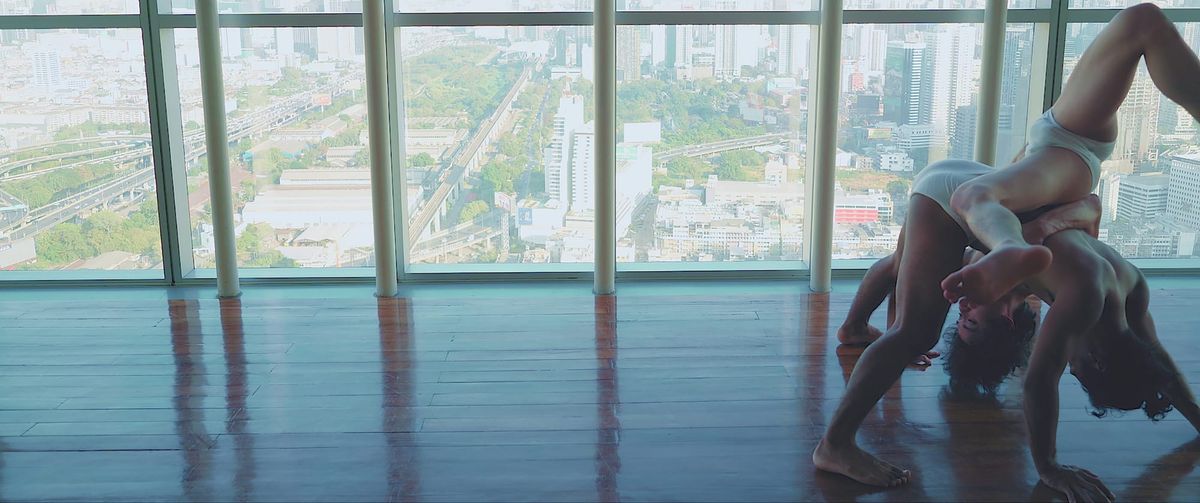
Thunska Pansittivorakul (b. 1973) is a Thai filmmaker whose work over more than two decades has occupied a singular space in contemporary cinema. For many viewers outside the kingdom, encountering his films requires navigating a landscape of deliberate scarcity, since most of his filmography exists primarily through international festival circuits, while very few of his works can be seen legally on small, specialized streaming services. My own entry point into his cinema began with The Terrorists (2011), a film that confronted the military's 2010 crackdown on Red Shirt protesters by intercutting raw documentary footage of state violence with explicit queer intimacy, a collision that treats cinema and memory as confrontation. Following his subsequent career meant tracking an artist who in many ways used cinema as a formal counter-strategy against internal colonization and forced amnesia.
This amnesia is a structural pillar of the contemporary Thai state. As the historian Thongchai Winichakul has noted in his analysis of the October 6, 1976 Thammasat University massacre, an event that recurs in many of Thunska’s post-2010 films, the memory of state-sanctioned murder exists in a condition of "unforgetting," a trauma too destabilizing to the official national narrative to be either fully absorbed or completely erased. Thunska's cinema directly targets the narratives, monuments, and rituals that sustain this vacuum, demonstrating how the political ecosystem conditions people, even ones from marginalized communities, to defend the very institutions that oppress them.
His work can be understood through the lens of internal colonization, in which the political center in Bangkok tames, exploits, or eradicates the periphery to define a rigid, hyper-sanitized "Thainess." In a way, we can read many of his films as an atlas of this marginalization. This atlas traces a geography of exclusion, moving from the state's complicity in violence against Karen refugees in Supernatural (2014) to the rhetoric surrounding stateless communities and anti-Chinese pogroms in Santikhiri Sonata(2019), then from the historical taming of the Northeast in Isan Odyssey (2025) to the total abandonment of Muslim communities in the South in Are We Monsters? (2026). In Supernatural, this structural violence is tied explicitly to a civic religion centered on the monarchy, justifying the elimination of the "other" under the guise of building a secure, unified kingdom of "good people."
Thunska weaponizes the body and non-normative sexuality to resist this demand for sameness. His early work drew both celebration and criticism for its raw sensuality, while some of his later films use homoeroticism as a radical form of political non-compliance. In Supernatural, the collision of traditional Buddhist mantras with sensual imagery disrupts religious authority, exposing how economic and technological development can coexist with deep political stagnation. By the time of Are We Monsters?, this framework develops into a universal critique of power, in which to be queer is to refuse the rigid, unitary identities pushed from above, whether by Central Thai hegemony or local religious orthodoxy.
In some of his recent works, Thunska's formal language has shifted toward a more direct, indexical documentary style. Both Isan Odyssey and Are We Monsters? employ onscreen maps and geographical markers to ground the viewer in the material reality of the margins. In Isan Odyssey, he traces how mor lam music, once a vital sonic form of regional resistance against internal colonization, was systematically co-opted by the capitalist entertainment industry, its political edge dulled in the process.
This brings his career to a genuine turn. Isan Odyssey was produced under a condition none of his previous features had to meet, since it had to screen inside Thailand. Released domestically through Doc Club Originals, the film arrives in a country where, as Thunska himself has said, defiance carries real consequences—a heavily policed domestic space where public challenges to the status quo, especially the monarchy, are routinely met with years in prison under the lèse-majesté law. The interview that follows addresses this decision directly, examining why he chose to finally engage with domestic audiences after decades of deliberately keeping his films out of Thailand.
Thunska's answers are presented here exactly as he composed them, broken into short, fragmented lines, a formal choice that mirrors the logic of his moving images.
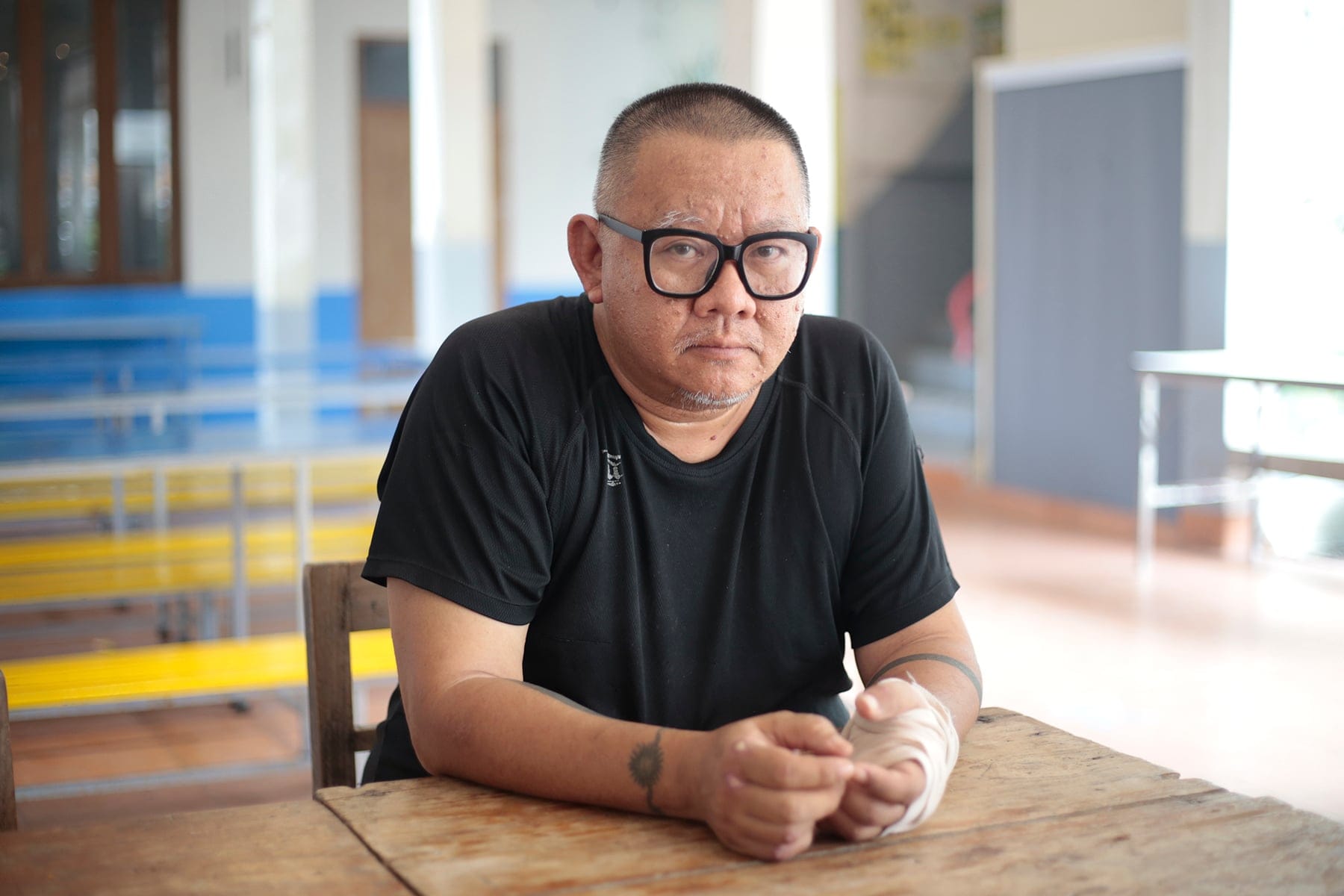
Watching Isan Odyssey, I was reminded of the aquarium in The Terrorists and, from there, of the fish and the weight that image carries. This kind of recurrence happens across your filmography more broadly—specific images, symbols, and formal gestures reappear in different contexts, carrying a different charge each time but also holding the weight of their previous occurrences.I am curious whether you think of the films as a single interconnected work with its own internal grammar, or whether those recurrences are something the material keeps insisting on independently of any plan you have for them.
I will answer each question one by one, and I think I will avoid reading the next question until I finish answering the current one.
You are the first person to make this connection. The Terrorists is a film from 2011, and very few people who have seen Isan Odyssey (2025) have also seen my older films. So I have to admit that, yes, the connection is there. However, it was not something I planned in advance. It is true that I often return to the same symbols, but sometimes their meanings shift and become something different.
In Thailand, we have many sayings about “fish.” For example, we are often taught in school that Thailand is a fertile and abundant country because “there are fish in the water and rice in the fields.” There is also a well-known teaching attributed to King Rama IX: “Do not give fish to the people; teach them how to catch fish.”
But in The Terrorists, the phrase I connected to was: “People are not vegetables, people are not fish.” I heard protesters chanting this during demonstrations against the government at that time. People are not vegetables without life, nor are they fish that can be killed so easily. This also connects to 1976, when a monk helped incite hatred by proclaiming that “killing communists is not a sin; it is like killing fish to prepare food for monks.”
I take these phrases—phrases that the political right has often used to indoctrinate us—and try to look at them from another angle. I often return to them again and again, repeating them like a recurring musical motif throughout my films. But I never plan these things beforehand. They are not written into the screenplay. They emerge during the filming process itself.
The section in question was filmed during a journey through different locations in Nakhon Phanom Province. In fact, we shot in many different places, but in the end I chose to include this sequence because of its striking and unusual visuals.
The fish that appears prominently is called the Mekong giant catfish (ปลาบึก/Pla(fish) Buek). It is an ancient species found only in the Mekong River basin. It is endangered, and its survival depends entirely on the quality of the “water”.
On another level, I personally think that the actor who appears in this sequence, when naked, has something in his physical form that resembles a fish.
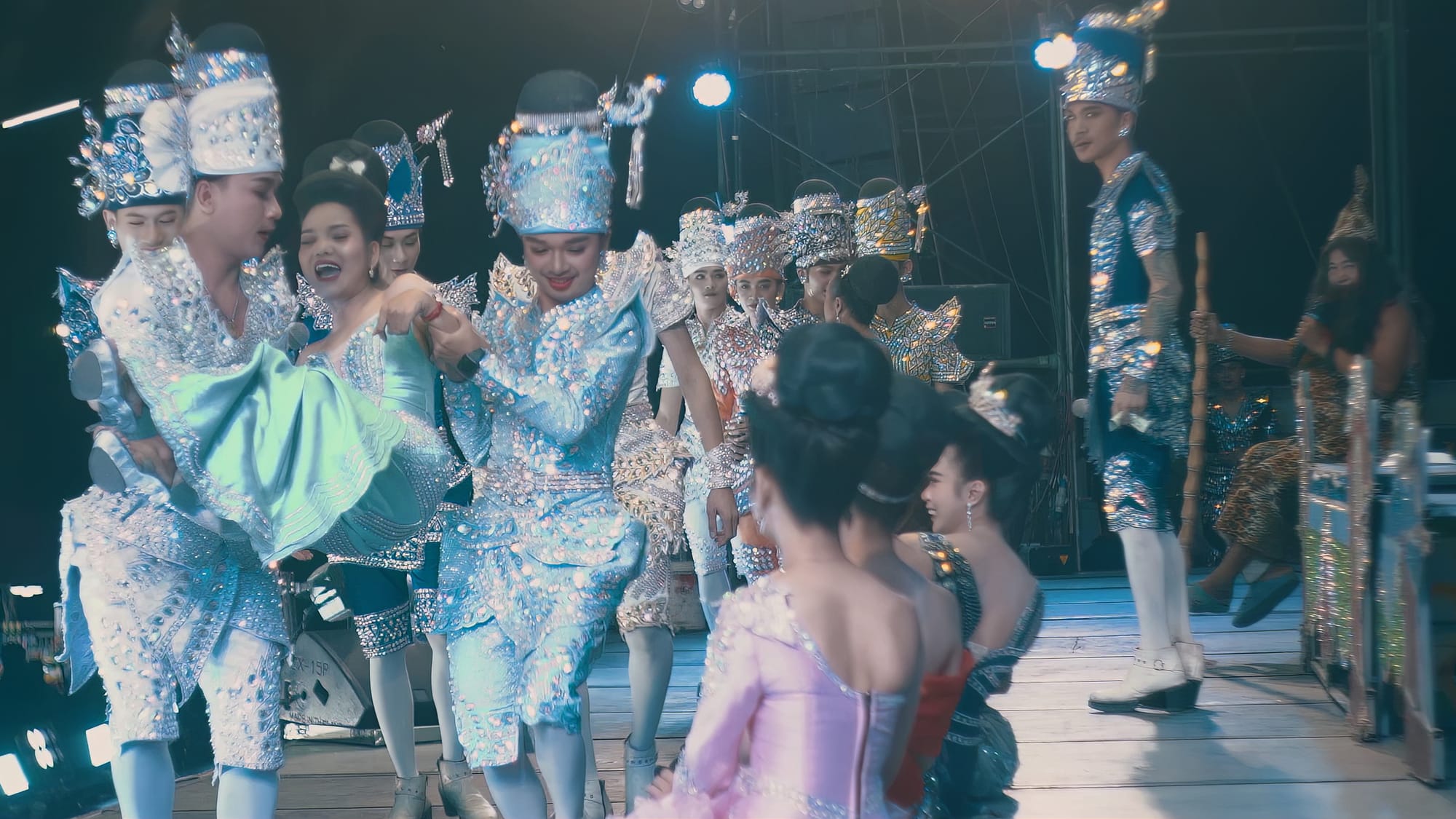
In Isan Odyssey, for instance, you allow the molam performances to occupy the screen for a long time as pure, unmediated spectacle—loud, joyful, physically extravagant—before the film begins to structurally position them within their historical and political contexts of industrial capture, violence, and oppression. This is a structural rhythm I notice across many of your films that I find very specific to how you work: we are immersed in an aesthetic experience before we are given its political context, and when it arrives, it retroactively transforms what we thought we already understood. When you build a sequence through this kind of delayed entry into meaning, what does that transition do for you that a more direct, expository approach from the outset would not?
Isan Odyssey was created under very different circumstances from all of my previous films. In the past, my films were never intended to be screened in Thailand because there are certain untouchable rules in this country—certain subjects simply cannot be represented.
However, this film was made with the requirement that it had to be able to screen in Thailand.
I believe the version you saw was the international festival version. There are a few images in that version that were self-censored in the Thai release, even though the overall content remains intact. For example, there is a scene showing King Rama IX visiting a military dictator. In the final skateboarding scene, the Thai version crops out a mural of the king that appears on the wall. These are relatively minor details.
The primary challenge was simply to make a film that could be screened in Thailand.
Most Thai people have never seen my previous work, and the general understanding of documentary cinema in Thailand is very much like what appears at the beginning of Isan Odyssey. In that sense, the film became a kind of game with the audience. It is almost like luring them into a documentary that they think is about molam, only for them to gradually discover that it is not only about molam at all.
That said, this is also a method that has always been present in my work, as you have correctly observed. The difference is that in my earlier films I usually did not linger in these moments for very long. I often begin by showing a familiar surface, allowing the audience to settle into it, before turning toward another side that has been buried or obscured.
But if I am to answer your question honestly, I have never really thought about the outcome in terms of how audiences might feel.
I only think about how I feel.
For me, cinema is a tool through which I release my thoughts and emotions about a particular issue at a particular moment in time. I take what I have been carrying in my head and in my heart and pour it out into the film.
Some people may understand it.
Some people may not.
And that is perfectly fine.
In both Danse Macabre and Isan Odyssey, you translate historical violence into a dancer's body, letting them physically enact what is being narrated through other means. I kept thinking about what it means to choose dance over other ways of reconstructing those events, like asking actors to retell the story, for example. What can a body in motion do with a violent event that other approaches cannot, and what does that translation cost the event, if anything?
I honestly do not know how to answer this question, other than to say that I simply like it.
The difference is that in Danse Macabre, the dancer wears clothes, whereas in Isan Odyssey, the dancer is shirtless.
Clothing determines status.
In Danse Macabre, I dressed the rapist-murderer character in white. Another dancer wears a white shirt with a floral tie and military trousers. Uniforms determine status. They determine ways of living, social position, class, and power.
In Isan Odyssey, I deliberately chose to make the dancer shirtless so that, while he dances, the audience can see the body of that young man. The story being told is about another young man of roughly the same age. He should have been able to live his life, move freely, dance through his youth, and enjoy being alive. Instead, he was killed because those in power did not see people like him as human beings.
The trousers he wears are khaki, and I chose that color for two reasons.
First, they refer to the uniform of Chulalongkorn University students, which is the university from which I graduated. We are often taught that this uniform was bestowed by the king and therefore should never be changed. Today the uniform is navy blue or black, but I discovered that, at the time, it was originally khaki.
Second, khaki is the color of the uniform worn by kharatchakan (ข้าราชการ). I am not sure there is an exact equivalent in English. When we speak of state officials in English, the term usually implies public servants. But in Thai, kharatchakan literally means “servants of the king.” The implication is that their primary duty is not to serve the people, but to serve the monarch.
I enjoy hiding these layers of meaning within each choice I make in the choreography.
Of course, before deciding on dance, I considered many other possibilities: dramatic reenactments, role-playing performances, animation, drawings—things that many people have already done before.
But I found that dance, especially a form of dance that is not what audiences normally expect, is more compelling to me. It invites attention. It invites reflection.
Perhaps I have hidden many meanings inside these scenes.
Or perhaps they mean nothing at all.
In the dance sequence, you will notice that the dancer smiles. During filming, we shot both versions: smiling and not smiling.
While making my previous film, Damnatio Memoriae, I came across information about Taiwan during the White Terror. Many people were executed, and some chose to smile in the final photograph taken before their deaths.
They smiled because, at last, they were going to die.
Death was preferable to living under a system of power that deprived them of freedom.
In that sense, dying could be happier than continuing to live under oppression.
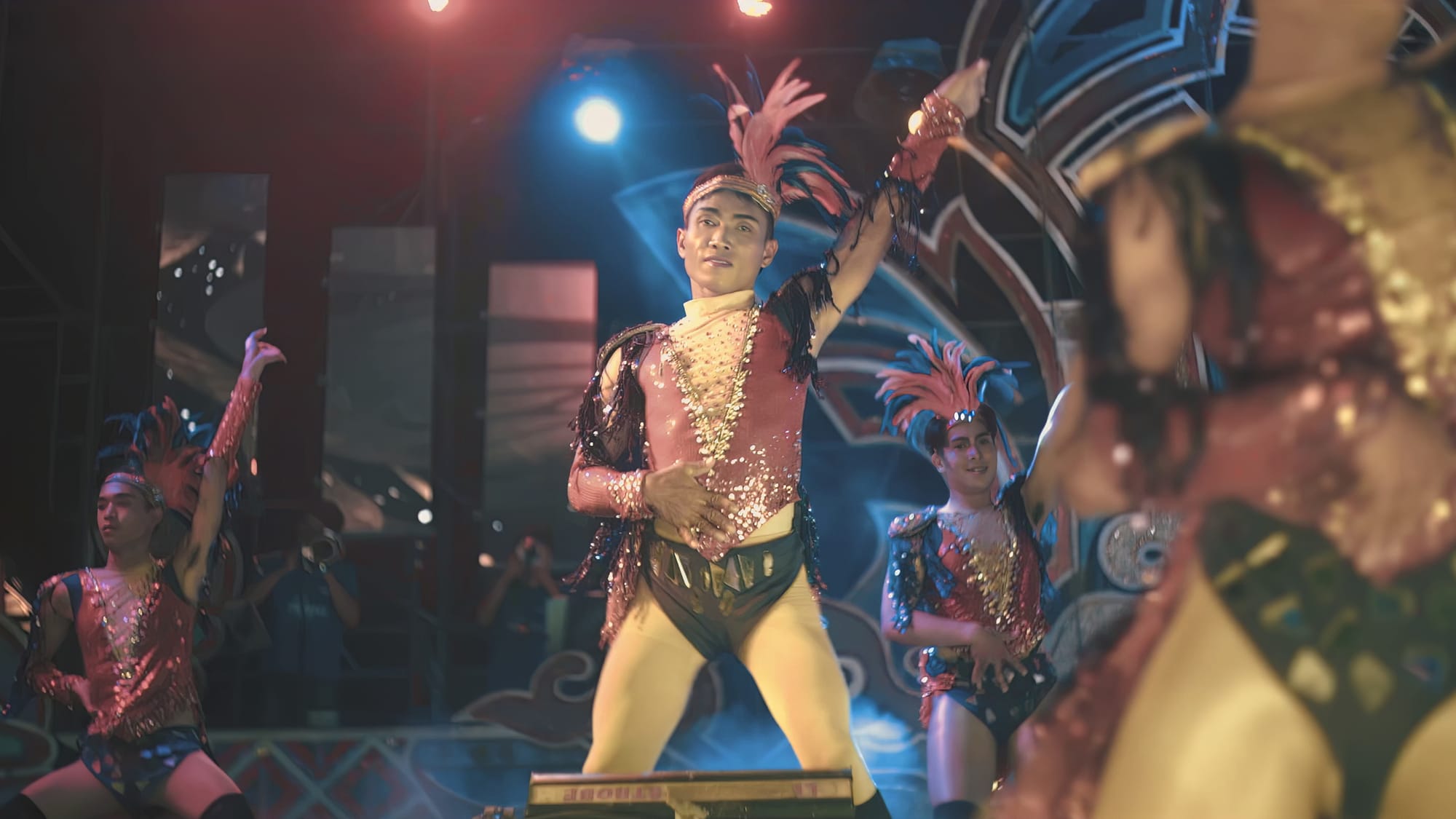
I want to move to something more personal for a moment. In The Terrorists, you recall a conversation with your mother about the 1976 massacre in Thammasat University. In the beginning, she says she does not know why the students were killed or that they were communists, but later admits to being a communist herself and having to flee to the South because the army was killing Chinese people. This makes me think about two distinct forms of erasure that run through your work: the institutional destruction of the past by the state, and the suppression of memory by the people who lived through it. Another version of this appears in Danse Macabre and Isan Odyssey, where young people do not remember what happened to their communities or in the spaces they live in. Having encountered that suppression so directly inside your own family, how has it informed the way you approach memory in your work, both with real people and the fictional composite figures you construct?
I am not sure how to answer this question.
To be honest, I have never consciously thought about these things. They simply flow out of me automatically.
One thing that has remained a trauma for me for a very long time is the realization that the power of images can be manipulated and reinterpreted by those in power.
During the Red Shirt protests in 2009, at a time when people had only recently begun uploading short video clips to Facebook, a friend of mine uploaded a video one morning. In the clip, two women appeared to be speaking incoherently, almost as if they had lost their minds. They were saying that around five in the morning a group of soldiers had arrived, rounded up protesters, and loaded them onto military trucks, leaving only the two of them behind.
They also said that a conservative man had violently pulled one woman's hair and torn her shirt, and that they responded by spitting at him.
The very same footage was later re-edited by the military. In this new version, the story became that these two women were insane, that they had attacked journalists and spat at members of the press.
At that moment, I immediately understood the power of documentary.
The following year, in 2010, the government claimed that there were armed men in black hiding in tall buildings, firing indiscriminately into crowds. One of the people who died was the son of a friend of mine.
The Thai state blamed the protesters for his death, and many people believed this accusation without asking any questions.
A false memory was manufactured for us.
And that false memory shaped beliefs, hatred, and relationships. It erased “us” as living, breathing human beings.
I feel that this is something profoundly fucked up.
And through the very same mechanism, I am trying to reclaim those things through the language of my cinema.
(I am not sure whether this actually answers your question.)
Looking across the films, I notice that many of the works are anchored in different marginalized communities at the edges of Thailand, something even more apparent in Isan Odyssey and Are We Monsters?. Bangkok and Central Thailand are in the films, but always through people whom the center refuses, molds, or worse, erases. I find that the films make you feel the weight of the center intensely precisely because it is never their direct subject. Do you think that would still be possible if you filmed the center and its mechanisms of control more frontally, or does keeping it as a looming danger do something that a more direct approach could not?
Let me answer the question this way instead.
I have grown older, and this October I will turn fifty-three. It was not until I was twenty-six or twenty-seven years old that I began to understand what was really going on.
I spent half of my life being deceived.
The history I was taught was the history of the center, a history in which marginalized people did not exist at all. I learned about the virtues and greatness of every king, but only their positive sides. I think half a lifetime spent absorbing those narratives is more than enough.
That is why what I seek, and what I try to present in my work, is no longer a return to those centers of power.
On a personal level, I am also a gay man. Although Thailand has now passed marriage equality legislation, gay people are still outsiders. We are still marginalized within Thai society.
Of course, I have certain privileges. I was born male, and I am the eldest son of the eldest son in my family line. Yet that position has only made me look at masculinity, and at my own identity as a man, from a different angle within this deeply patriarchal society.
But if your question is really asking whether I should point my camera directly at the center of power and attack it head-on, then I would answer this way:
When Isan Odyssey was released, many people told me how brave I was for presenting these things on screen.
But I have to admit that this is not true.
I am actually very cowardly.
All I have managed to do is speak within the limits of the ceiling imposed by the Thai state.
In reality, I am deeply afraid.
I am constantly aware of how dangerous the things I do can be, and I am extremely cautious.
Most people may not realize that Thailand today has many political prisoners, many exiles, and many people who have been disappeared or murdered, as shown in Isan Odyssey.
And I am still afraid that one day I may become one of them.
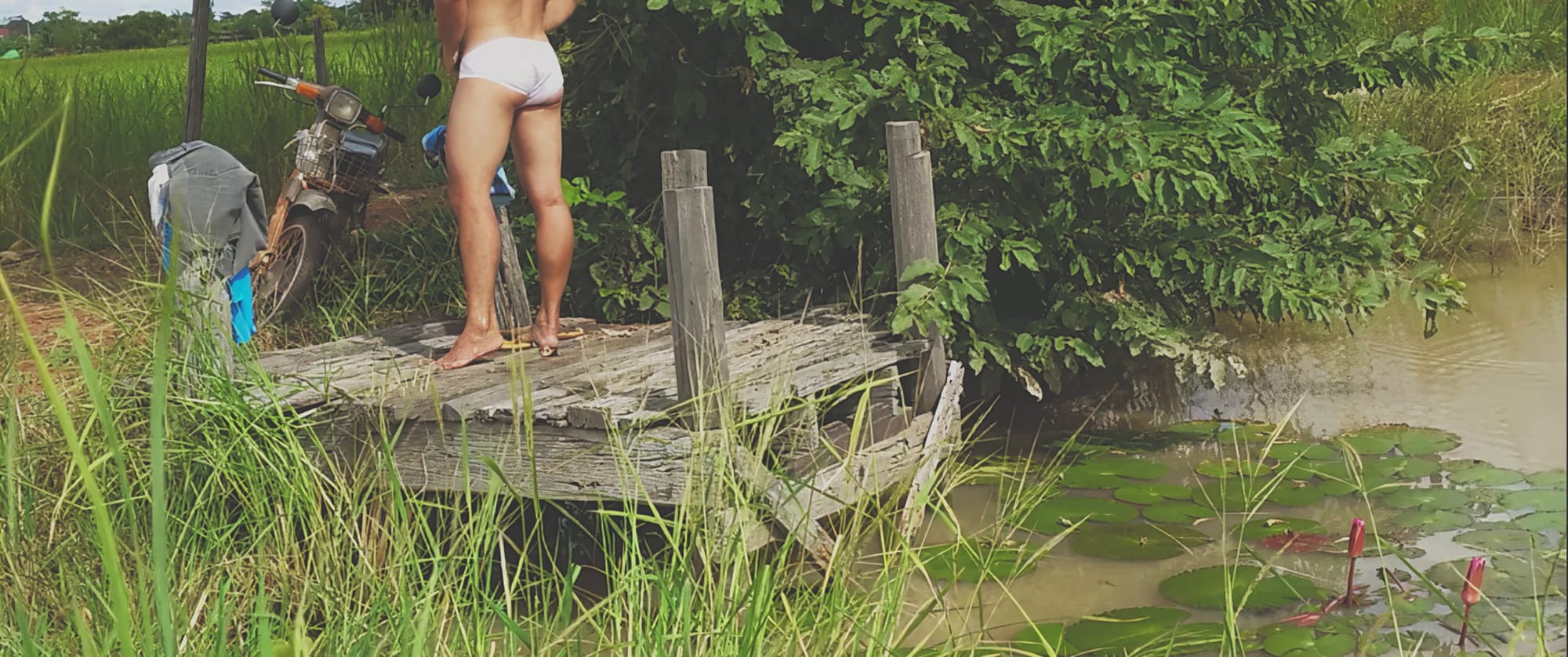
In many of your films, such as Santikhiri Sonata, Supernatural, and Isan Odyssey, you use testimony in a way that deliberately moves past the conventions of traditional non-fiction. But rather than masking the border between reality and performance, you present figures who I see as enhanced or transparently constructed composites. I am fascinated by how you deploy this hybrid approach across two vastly different political positions. On one hand, you use these stylized figures to articulate the collective identity and historical trauma of marginalized communities. On the other, you construct bodies and interiorities for those who defend the state, transforming royalist propaganda into statements that feel both very real and yet, unreal in their anti-humanity. What does this act of composite construction, rather than literal capture, allow you to access that a standard recording would close off, and does it work differently depending on which side of that divide the figure stands on?
It seems that I already answered part of this question in my previous response, but I will try to elaborate further.
I hide myself inside those figures.
I use those bodies as a space through which I can express satire, irony, provocation, and also my own doubts, fears, and cowardice.
For the first half of my life, I was a loyal subject. I never questioned anything. I never doubted anything.
But the second half of my life has been haunted by wounds that cannot be erased.
They have become deeply embedded memories, memories that constantly remind me who the architect behind all of this is, who the real enemy is, who “the one you know who” is.
And yet I still have to live in this country.
I still have to tell these stories and make these films within this country.
Watching Isan Odyssey, I kept thinking about something that runs across all your films: the communities you document are all subject to largely the same structural forces of control, erasure, internal colonization, and uniformization. Yet, each is distinct in the particularities of how they have been molded by the center, often resulting in a total loss of local identity where historical memory is forgotten and the instruments of oppression are embraced as saviors. When each new film enters through a specific place that has been violated by the same system you have already documented elsewhere, how do you keep visible the specific texture of that loss without letting it get completely drowned out by the repeating, uniform pattern of state violence?
If you have ever been subjected to violence, you never forget who did it.
At my age now, the people around me who share the same ideals are gradually dying off. One day, it will be my turn as well.
I have never really thought about how I preserve these memories, because, as I said before, they emerge automatically. They simply pour out of me during different stages of making a film.
Much of this comes from the trauma of 2010.
And to be honest, the Thai state has never really changed the way it uses violence against its people. Even after hundreds of years, it continues to rely on the same methods.
And the people continue to lose, just as they always have.
One of the things that makes that specificity visible in Isan Odyssey is the archival material, particularly the anti-communist posters aimed directly at Isan. I show the same posters in my classes on propaganda and the relationship between mainstream culture, America-sponsored state violence, and the Cold War. When you place the posters in relation to both contemporary and archival footage, I am curious what you think happens to them. Do they indict themselves simply by being seen in a new context, or does the placement have to do something more active than that, or are they maybe in a conversation with the mainstream culture serves power now?
I do not know whether other countries have already moved beyond the Cold War, but Thailand remains trapped within it. We are perpetually living in the Cold War. Only the language changes.
The enemy that this country continually invents is always the same: “those who want to overthrow the monarchy.”
Thailand teaches that communists have no religion. Therefore, they do not support the monarchy and seek to overthrow it.
The Red Shirt movement that demanded democracy in 2010 were labeled “anti-monarchists” because they supposedly preferred a republican system.
Muslims in the Deep South who are accused of wanting a Sultanate state rather than the Thai monarchy are also labeled “anti-monarchists.”
Even political parties that win the largest number of votes in democratic elections can ultimately be prevented from forming a government because they are accused of being “anti-monarchists.”
It is the same Cold War narrative over and over again. Only the names change. Only the actors change.
The Thai state remains stuck in an older world, relying on the same methods it has always used.
However, if you look carefully, you will notice a contradiction in that propaganda poster.
What do you see in this image?
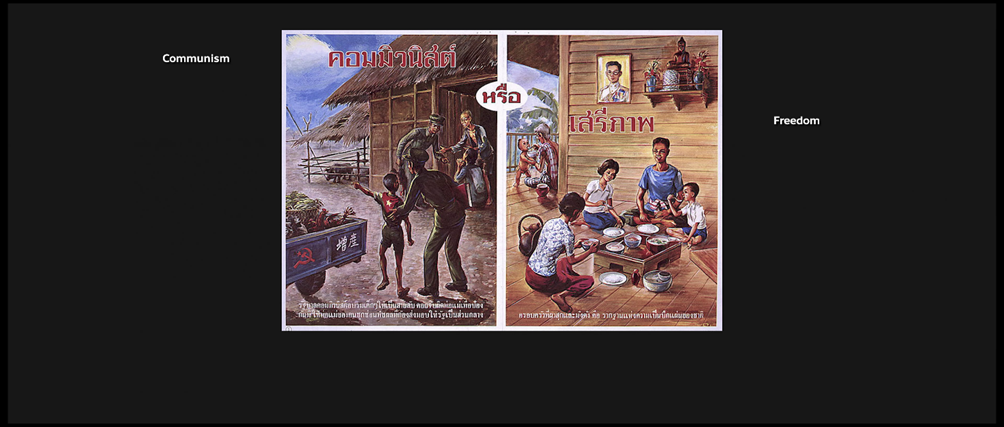
Thailand has a strict hierarchy. The language we use, even the pronouns we choose for different people, reflects social rank. The king must always be above everything else.
That is why I find this poster so fascinating.
You can see that there is an image of the king in it. The word above him is the Thai word for “Freedom.” But in Thai visual culture and traditional hierarchy, you cannot place text above the image of the king. The king must occupy the highest position.
This creates a remarkable contradiction.
The word is “Freedom,” yet it cannot be positioned above the king.
It speaks about freedom, but it is a freedom that Thai people have never truly possessed.
In the English version of my film, I place the word “Freedom” in exactly the same position as the Thai word appears in the original image.
And these contradictions are not relics of the past.
They are still here.
They are still part of the present.
And they will probably remain this way for a very long time.
Those posters use images and popular culture as instruments of control. I want to ask about another kind of image that runs through your work: the body itself. In Matthew Hunt's book on censorship in Thai cinema, you spoke about the sexual content in your films in a way I found more complicated than how critics usually read it, and more interesting than I was initially inclined to interpret it. You suggested the masturbation in your work prior The Terrorists is about a temporary dreamlike escape, because eventually you have to wake up to reality and you cannot break out, but this changed with The Terrorists. You also pushed back against the desire to turn the dead into political heroes, comparing them to casualties in a war that is never won. I often think about these positions—the body as temporary escape rather than resistance, the desire for happiness, and the refusal to romanticize the dead—when I watch your work. How do those two ideas shape the way you film the human body, and have they stayed consistent across the work, or have they shifted?
I am genuinely amazed by this question.
Believe it or not, I once thought that certain questions might have different answers as time passed. But now that you have asked me this question again, at this moment in my life, I find that my answer has remained remarkably similar.
And do you know something else? Right now I am using AI to help translate my answers. The translations are actually much closer to what I want to express. My English is not very good. When I gave that interview to Matthew Hunt, I was still relying on older translation tools, and I often felt that they failed to convey exactly what I meant, especially in certain nuances.
Nevertheless, yes. And if you have paid attention to my answers so far, you may have noticed that I still firmly believe the same thing: we will never win.
What I have learned this year, however, is something beyond that.
The universe moves toward disorder.
The body is something ordered and organized, but it is not eternal. It is only temporary.
The same is true of happiness.
For this reason, I do not see these people as heroes.
Of course, I admire their courage. I admire their willingness to fight for their ideals.
But in the end, I refuse to see them as sacred figures.
Perhaps the best way to answer this question is through this image.
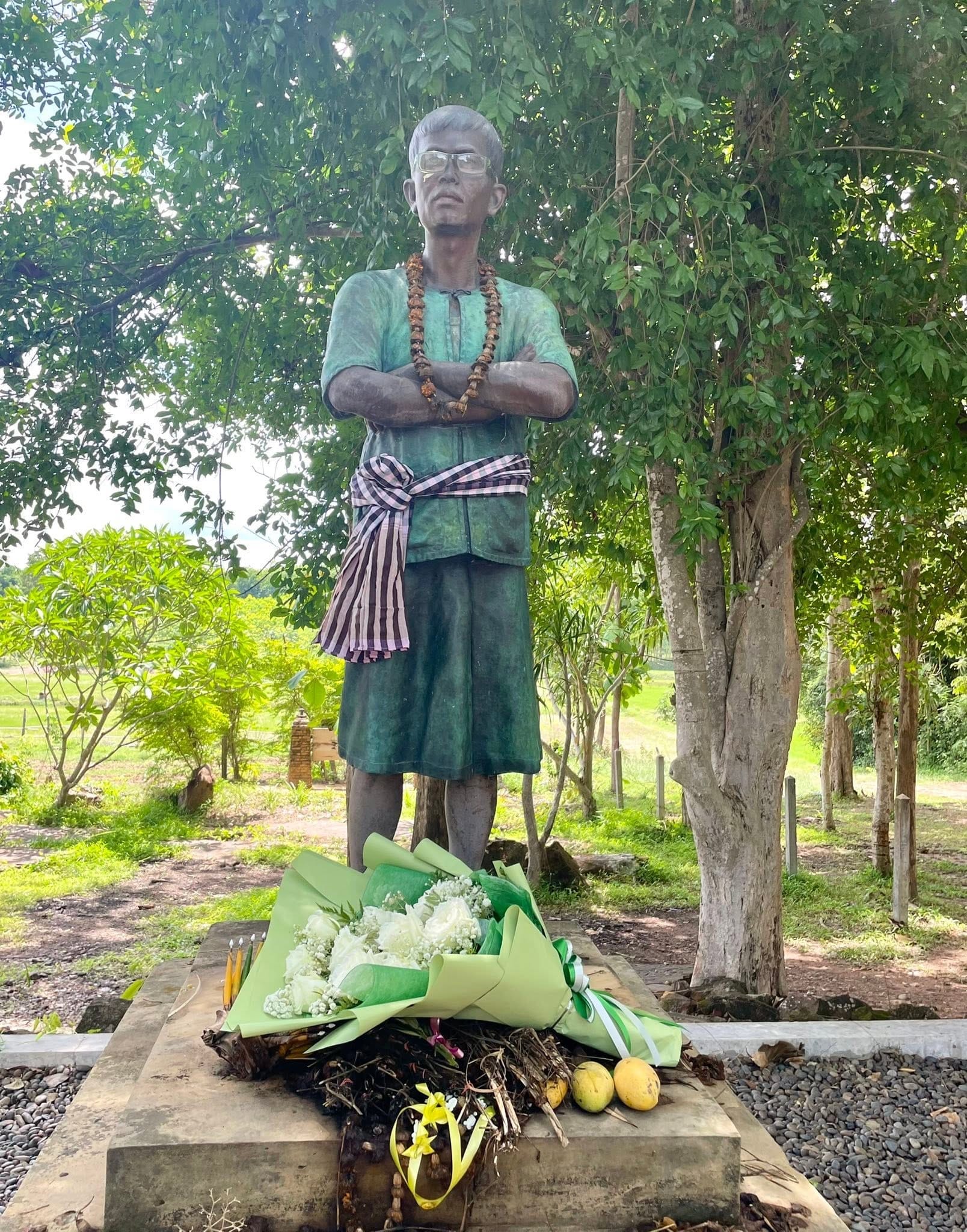
This is actually a real photograph of the statue of Jit Phumisak, a side of the story that does not appear in my film.
Another reality is that people replace the cloth wrapped around his waist every year. They put real eyeglasses on him. They offer flowers, food, and mangoes because they believe these were things he liked. Some even believe that he can bring them good fortune and help them win the lottery.
I regret not including this aspect in the film.
In the eyes of many villagers today, Jit possesses the power of a sacred being.
But I can never see him that way.
If I did, it would contradict the ideals that Jit himself believed in, and it would also contradict what I believe.
What fascinates me is that those who believe in him use this statue as a substitute for Jit's body.
Do you understand what I am trying to say?
Sometimes I genuinely do not know how to express these thoughts in words.
I have never been particularly good at explaining things through language.
Perhaps that is precisely why I chose cinema instead.
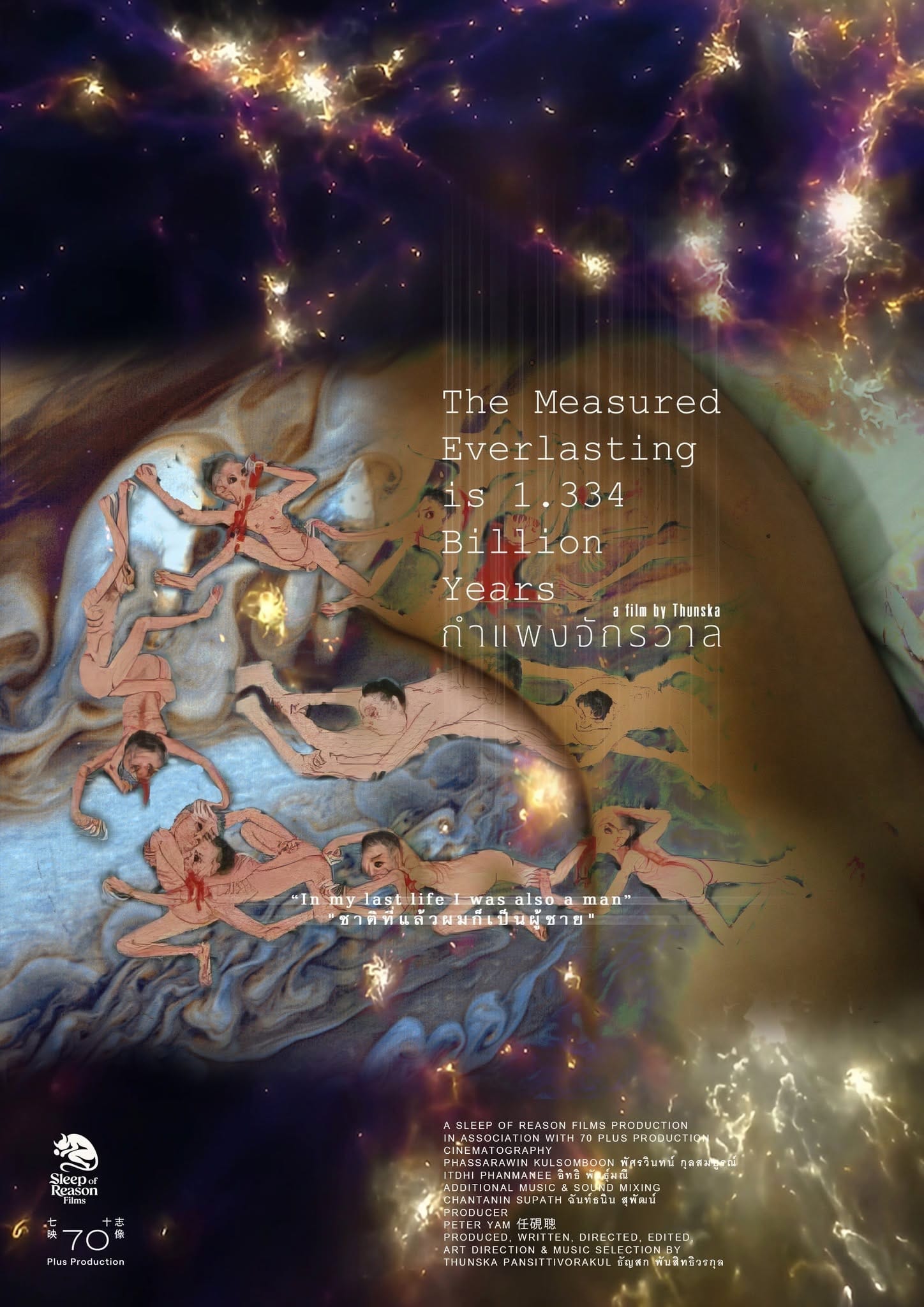
In fact, I have just finished a new film. It is about to enter competition at a European festival later this year.
It is probably the most explicit film I have ever made.
It combines Thai Buddhist beliefs with physics.
If you are interested, I could share it with you.
But the film has not had its world premiere yet, so you would have to keep it completely confidential.
I must wait until the festival makes its official announcement first.
Several of your films end without resolution and without the kind of therapeutic release that more traditional, issue-driven non-fiction works usually provide, though the final shots always point to the structural architecture behind it all; Isan Odyssey is a very clear example of this. I see all of your works pointing at the same localized source of oppression and violence—what you call in Supernatural "The Leader." I have come to think that this refusal of closure is not simply a formal preference, but a core argument of your practice: that because the violence and the system the films document have not ended, the films cannot end in any way that would offer false comfort. Is that refusal of closure a direct claim about the ongoing political reality outside the films, a deep distrust of cinema that tries to wrap trauma up too neatly, or something else entirely?
It is all of the things you mentioned.
Perhaps this also comes from the long-standing debate around documentary cinema: should documentaries remain neutral? Can a documentary take sides? How much of our own personal opinion are we allowed to express?
For me, the moment you make a film, it already becomes an expression of your personal point of view.
In recent years, however, I have increasingly preferred to throw facts at the audience rather than tell them directly what I think, as I often did in my earlier work.
I am much more cautious now about inserting my opinions explicitly into my films.
Many of my recent works are constructed by presenting one set of facts and then following it with another set of facts that contradicts the first.
I enjoy these moments very much.
They reveal the diversity of people. They reveal that history has unfolded this way before. They reveal the human condition, and how cruel human beings have been capable of being.
And they also reveal that much of humanity's attempt to present itself today as virtuous is, in reality, little more than propaganda.
When you make a film, every decision carries meaning.
Whether you choose a 4:3 frame, 16:9, or 1.85:1; whether you choose slow motion or a fade-in—these choices are always trying to communicate something.
And the same is true of endings.
A happy ending is something I have never chosen.
We have been conditioned, especially by Hollywood cinema, to believe that stories must end happily.
But that is not true.
And because it is not true, I do not believe in it.
And because I do not believe in it, I cannot allow my films to end that way.
For most of your career, your films have circulated almost entirely outside Thailand, through international festivals and specialist platforms. Then, Isan Odyssey was released theatrically in Thailand through Doc Club Originals. From what I have read, the version shown locally is different from the one that has traveled internationally. I find myself genuinely uncertain how to think about that situation—whether releasing a modified film domestically is a different kind of reach than not releasing at all, or whether the modification changes something fundamental about what the film is.What made that domestic release feel worth doing, and how do you think about the operational difference between these two distinct versions of the work?
I do not really think in terms of whether it was worth it or not.
I do not have that much life left.
At this point, I simply try to finish one project so that I can move on to the next one. That is honestly all I think about now.
As for the rest of your question, I believe I have already answered it.
I live my life in fear.
I am cowardly, and I am afraid.
And this is the best choice I am capable of making at this moment in time.
I still want to stay alive so that I can continue making films.
Although I once set myself the goal of never making another film intended for theatrical release in this country, I also enjoy experimentation.
And for me, making a film that can be screened in Thailand is simply another experiment.
In your early films, the camera has a closeness and mobility that feels inseparable from what those films are able to show, a way of getting near things that more institutional filmmaking could not. Since then, your tools have expanded considerably. Your most recent films like Isan Odyssey and Are We Monsters? utilize drone footage, AI, and sharp, saturated images. These are also the instruments through which states now monitor and control populations, and I find that tension genuinely interesting. When you are working with the same tools the state uses to watch people, does that create something you have to work against, or do you think the camera is indifferent to who is holding it and what matters is entirely the use?
When I reached this question, I found myself asking, “He must think I am much smarter than I actually am.”
I am just a stupid filmmaker.
I am not wealthy. I do not have much money. I do not have many choices when it comes to equipment.
If you have seen Damnatio Memoriae, which consists entirely of archival footage, that was because it was made during the COVID period, and there was simply nobody available to help me.
When I was younger, I could still shoot my own images with simple equipment such as a handycam. Later, I discovered that modern digital cameras produced much sharper and more beautiful images, and their files were much easier to handle in the editing process.
But eventually I realized that my eyesight was getting worse.
I can still edit, but I can no longer shoot properly because my eyes can no longer distinguish focus distances the way they used to.
The drone shots I use are there because those scenes require a drone in order to tell the story.
In Isan Odyssey, I wanted the audience to see the landscape stretching across both sides of the Mekong River. I wanted them to see the mural on the wall, and to understand exactly where that woman was standing when she described the event.
That place is a space of power.
There is the monarchy. There is the Naga king. And then there are ordinary people standing by the Mekong River—the river that marks the border between nations—asking for justice.
The same applies to Are We Monsters?
The drone was simply the tool that could bring the audience as close to that island as contemporary technology would allow.
I do not use these technologies because of any particular theory about surveillance or power.
I simply use them to obtain the images that I need.
When the king died in 2016, I had just moved to Bangkok from Nakhon Ratchasima. What struck me was not that ordinary people grieved, I expected that, but that people I knew from the music underground, people I had thought of as operating entirely outside the mainstream and against the dominant culture, also mourned. Some even became monks to make merit for their dead king. That suggested to me that the hold of the monarchy and the cult of personality operates at a level that has nothing to do with political position or cultural affiliation. It feels closer to what you explore in Supernatural: the fusion of religion, governance, and cult of personality into a perfected version of the Three Pillars from the 2014 cultural mandates—a single apparatus that produces genuine devotion rather than mere compliance. This makes me wonder: how do you film a form of power that has made itself feel like love?
It is nice that you once lived in Thailand. How long were you here?
It is interesting that you were able to witness this side of Thai society. As for me, I have had to live with it my entire life, and I will probably continue to live with it until the day I die.
I no longer have a religion.
I often worry about what will happen to my body after I die. Most likely, my funeral will still be conducted according to Buddhist rituals, even though I am not happy about that at all. But what can I do? By then, it probably will not matter to me anymore.
What you describe certainly happened with King Rama IX, but it did not happen in the same way with others.
And yes, the people who loved him loved him sincerely. It was not because of fear.
Thai people have a strong concept of gratitude and indebtedness. Many believe that the prosperity and abundance of this country exist because it is protected by the monarchy, and that every Thai person owes a debt of gratitude to the king for this benevolence.
Therefore, you are taught to be grateful that the king allows you to live on his land. You must love him. You must revere him. You must not question him.
This is something King Rama IX was extraordinarily successful at: constructing an image of himself as a “good person.”
Thai people love “good people.” That is why every military junta throughout modern Thai history has always claimed to consist of “good people.”
Within this logic, if someone thinks differently—for example, if they do not love the monarchy—then they automatically become a “bad person.”
As for your question, “How do you film a form of power that has made itself feel like love?”
I do not know.
But I think I have already done it.
The kind of films I make are often seen by conservatives as the work of someone who is “unpatriotic” or who “does not love the nation.”
Yet I think I know very well how I feel about this country.
However, I would offer a small piece of advice.
You cannot judge Thai people through the lens of someone who comes from a more developed part of the world.
If you try to see them through the worldview that they themselves inhabit, many of these things will begin to make sense.
We Thais are not quite like any other people in the world.
And we are not the same as North Korea.
In fact, I sometimes think that the Thai model of governance is one that North Korea would envy.
And believe it or not, on the international stage, when you try to present the problems of Thailand to audiences who have no prior knowledge of the country, many of them simply cannot see what the problem is.
Everything is ambiguous.
Nothing is entirely clear.
It does not look like Iran.
It does not look like Russia.
It does not look like China.
Or even the USA.
We have developed a model that is extraordinarily effective at deceiving the eyes of the outside world.
Because we are extraordinarily effective at deceiving ourselves.