Opacity Is a Condition of Possibility
Filmmaker and geographer Rouzbeh Akhbari discusses informal maritime labour in the Strait of Hormuz, limited access, and the routes made through weather, trust, debt and risk.
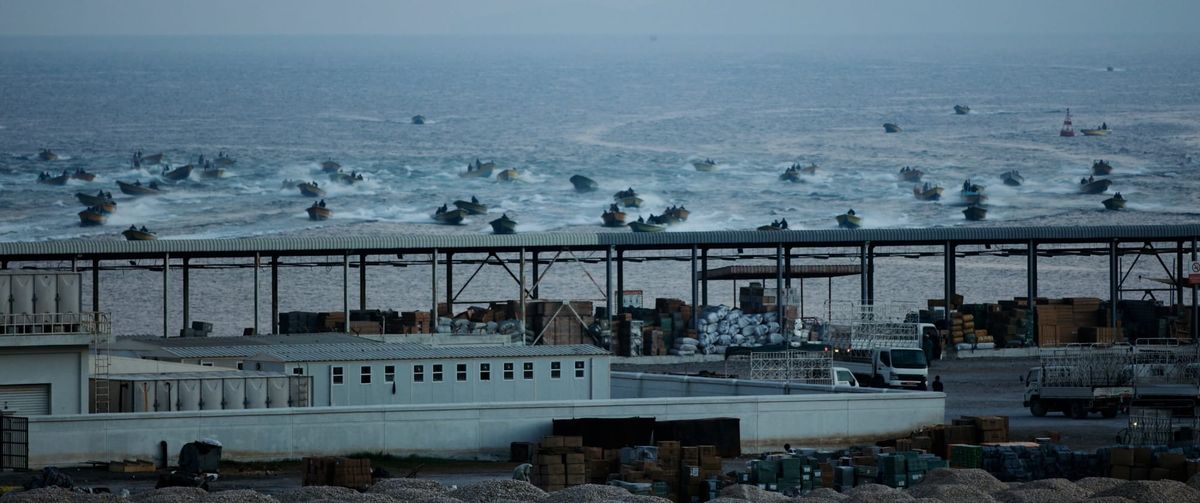
For centuries, people, animals, and goods have moved along trade routes stretching from the Caspian Sea to the Strait of Hormuz. These networks continue to operate today, shaped by shifting borders, economic sanctions, and large-scale infrastructure projects. Iranian artist and human geographer Rouzbeh Akhbari turns his attention to these routes in his first feature-length film, Crossings: Kaleh Ziyarat (2026).
Combining observational footage, archival materials, 3D animation, and poetic narration, Akhbari follows the livestock trade and the movement of people and goods across a region shaped by colonial histories, geopolitical interests, and economic sanctions. The film looks at how local communities sustain these networks and navigate changing political and economic conditions. In tracing these routes, Akhbari examines the relationship between geography and power, and the ways territories are mapped, represented, and controlled.
You have traced the project back to a 2021 visit to a currency exchange shop in Toronto, where a conversation about your mother’s pension opened onto informal financial routes through Kuwait and Georgia, and ultimately onto the movement of sheep across the Strait of Hormuz. You have said that the owner became reluctant when you asked for more detail. When you later began your fieldwork, how did that early encounter shape your sense of what could be asked, answered, and, later, filmed?
The hesitation of the exchange shop owner was important for me because it showed me that I had reached a limit. At first, I think I treated the conversation almost as a thread that I could continue following to any end my heart desired. But when she became reluctant, I understood that this was not simply a story waiting to be unraveled. The reluctance was itself a key information for me. It told me something about how knowledge circulates within informal trade networks and frankly that aspect interested me more than the details of the story.
Later, during fieldwork, I became more attentive to when people changed the subject or when a conversation became more general. I meticulously recorded those moments in my fieldnotes as an integral part of the structure I was studying.
Filming introduced another level of responsibility, of course, because a camera can expose much more than a conversation. Even when faces are absent, a sequence of actions reveal a lot about people and locations. So the question was not only what I was able to film. It was also whether filming something would alter the conditions that had made my access possible in the first place. This process was a constant check-in with whomever was accompanying me during each phase of the film.
Your 2021 novel and your academic research had already approached the Strait through archives, historical fragments, and, in the case of the novel, invented voices. What became possible in cinema that those text-based forms could not do in the same way?
The academic work helped me understand some of the historical and political structures behind these routes. The novel gave me more freedom to work through gaps in the archive and to dance with fictional voices that could traverse different times and places. But both forms remained very dependent on language. Cinema allows me to engage with the rhythms and choreography of movements across the Strait of Hormuz in a more multi-dimensional way.
For example, in writing I could describe a crossing as dangerous, but cinema allowed me to remain with the suspenseful waiting that comes before the journey. In the cinematic encounter, the routes stops being only an imaginary line between two points, they become a temporal spectrum made of preparation, boredom, fear, excitement and exhaustion.
Sound was especially important because so much of the spaces in my film cannot be fully seen. At sea near dawn, for example, you hear engines before you see the boats. Sound can suggest another activity taking place beyond the frame or beyond what I was allowed to film.
Cinema also allowed several things to remain unresolved at the same time. My voice over narration can move across centuries or make an association that is not literally visible, while the documentary image can refuse to confirm it. I did not want the boats or the workers to simply illustrate an argument I had already written. The images allowed for a certain level of opacity to be maintained.
You describe gaining access to Khasab through prolonged negotiation with non-state actors, without formal filming permission, and through a series of practical workarounds at sea and in the port. How did this dependence on informal relations shape not only what you could film, but also what you felt you should not film or disclose?
The lack of formal permission did not mean the absence of ethical obligations. In some ways, it made those obligations more serious, especially because I had come to this project with very strict ethical research board protocols from my university. My access depended on people whose own position was often precarious, and who were carrying extra risks by allowing me to be present.
With that in mind, there were many things I chose not to film. There were also things I filmed but decided not to use. I specifically avoided revealing precise routes, operational details, names, identifiable relationships and particular forms of cooperation that could affect someone’s ability to continue working.
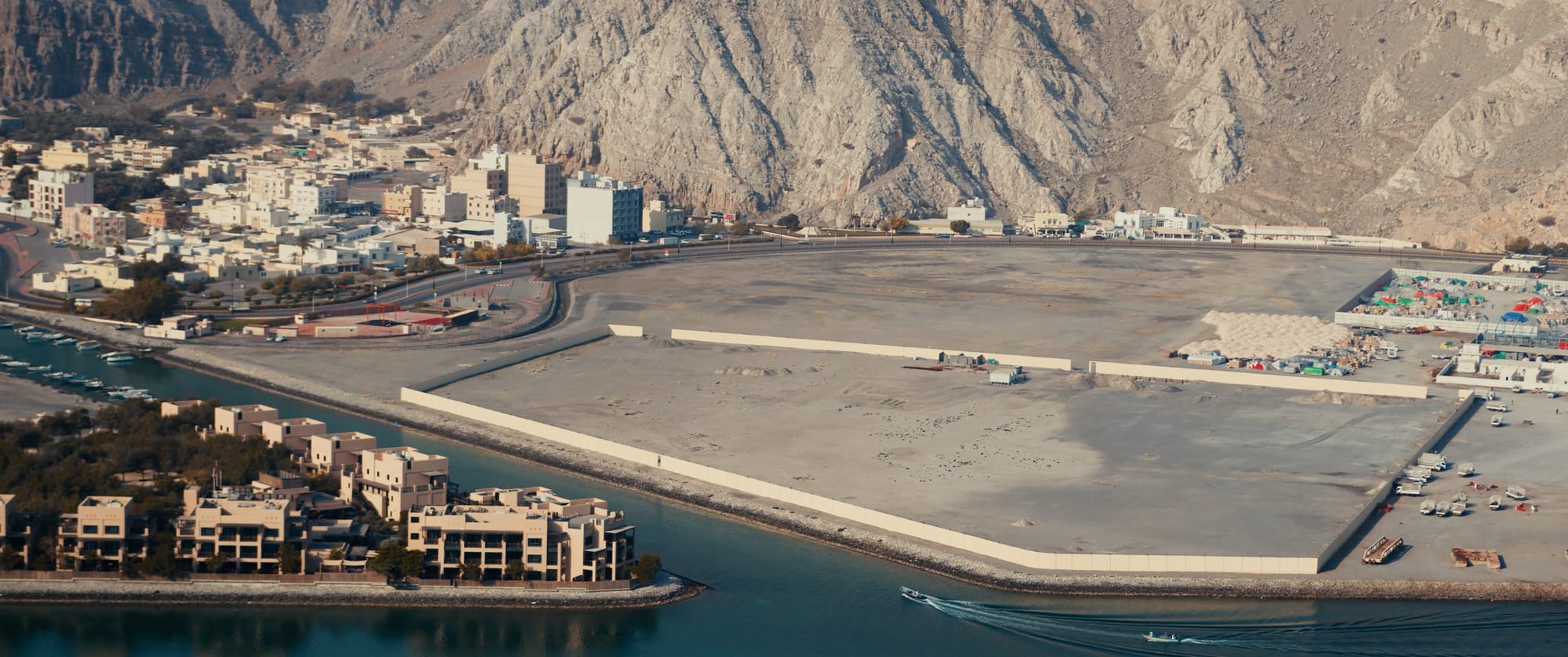
Most of the time, I found that the most responsible cinematic approach was to keep the camera at a distance far from the port and look into it over the walls through the space vantage point that any public spectator would have.
I am very aware that commonly documentary films use access as proof of their authority. The filmmaker shows something supposedly hidden and then presents that visibility as the value of the work. I do not want Crossings to function in this way at all. That’s exactly why some things remain indirect, fragmented or absent because opacity is a very condition of possibility along these maritime routes. The limited access and reach of this film, in my opinion, are its real strengths.
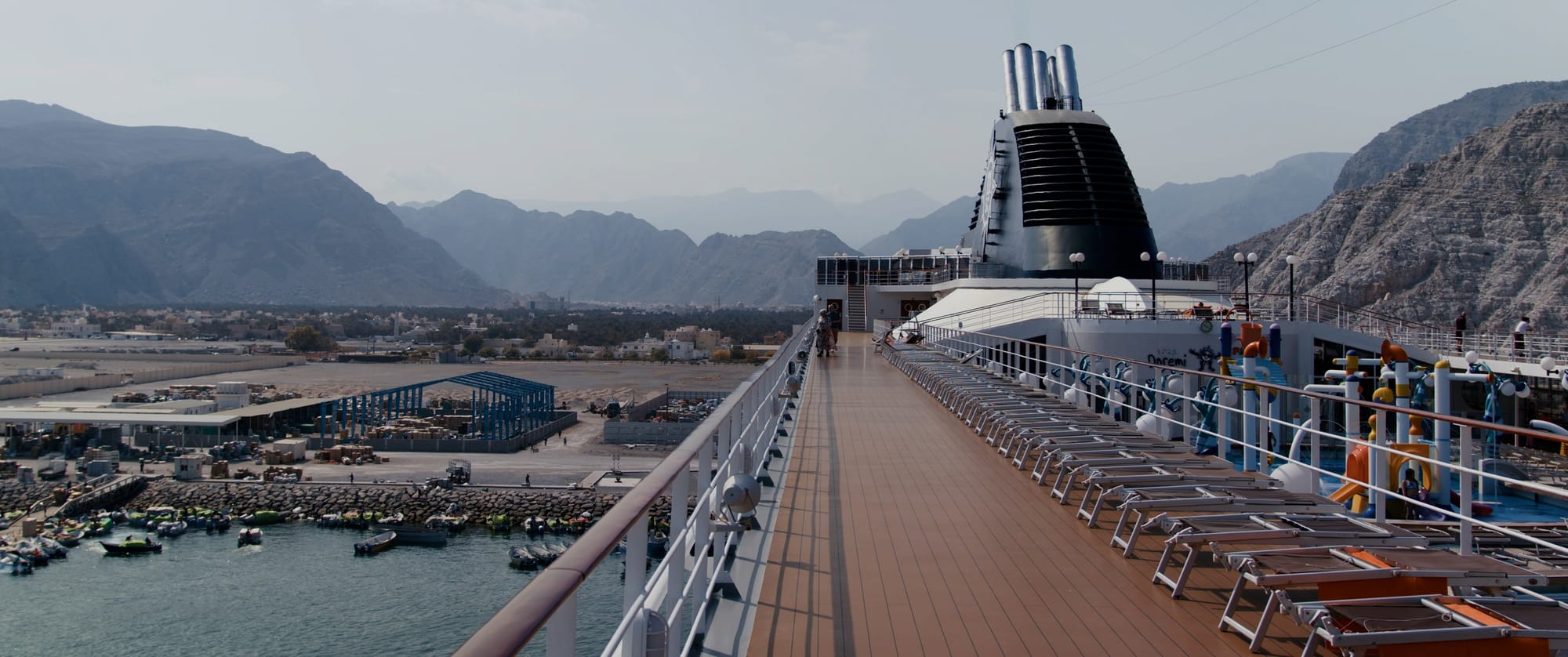
The narrator in Crossings: Kaleh Ziyarat observes how cruise tourism can turn a livelihood into a photograph. You also arrived at Khasab aboard the cruise ship that appears in the film, using a legal opening that made your entry possible. How did that position complicate your access to the port and the film’s critique of the tourist gaze? And how was the port presented to the tourists?
When I arrived in Khasab aboard the cruise ship, I had already been conducting fieldwork there for nearly three months. Before that, my access to the port had always been partial and negotiated. I was not allowed to enter most of the port areas and that’s why I was constantly searching for people or situations that could help me find other ways in.
When I returned as a cruise passenger, the experience was completely different. Nearly every view into the port that had previously been blocked was suddenly opened to me as a short term visitor. I could move with ease through spaces that had been restricted before. It made it very visible that an outsider’s access was not only about the physical sensitivity of the site but about the category through which a person arrives.
The tourist arrives as a temporary and institutionally legible visitor. Their mobility is expected, protected and arguably economically useful. I had entered the same port before as a researcher asking questions about informal trade, and that produced suspicion. On the cruise ship, I became part of a group whose gaze upon smuggling was pre-authorized and almost encouraged.
In the cruise promotional materials, the port was presented to tourists mostly through a picturesque image of Musandam. Jagged mountains, dolphins, Portuguese forts, traditional boats and the idea of an isolated or timeless coastal culture. The labor that sustains the port was either made invisible or turned into scenery that one encounters and is both enthused by and scared of. To an outside viewer on vacation with little knowledge of what is happening, the uncanny combination of beautiful landscape and speedboats filled with sheep quickly become attractive images without any explanation of sanctions, surveillance, border restrictions and intense militarization.
The film identifies itself as a story of hodology, a way of thinking through routes and movement, and I see it as one of its main concerns. What does this approach reveal about the Strait that is obscured when it is approached primarily through geopolitical maps, state borders, and maritime chokepoints?
A geopolitical map usually asks where the Strait is, who controls it, and what might happen if it closes, as we know too well now. It reduces it to a narrow passage between states and as a strategic point in the circulation of oil, military power and global trade. Those concerns are real, but they produce an excessively flat view of the Strait of Hormuz mostly from above and from the perspective of states and their associated actors.
Hodology begins somewhere else. It asks how a place is actually crossed, what kind of knowledge is needed to cross it, and what relations make that movement possible. When you approach the Strait through routes, it becomes a space made through weather, trust, debt, fuel, animals, bodies, engines, papers, rumors, family histories, missed phone calls and changing forms of enforcement.
An informal trade route is continuously made and remade through human practice. It can disappear when a port closes, when a new x-ray machine is installed, when the coastguard changes its patrol schedule, or when a political relationship shifts. At the same time, another route can emerge through a new relationship, an overlooked legal loophole, or a different form of geographical knowledge.
This approach also helps us see how maritime borders appear and disappear. The border is in some ways produced through the crossing itself. It can expand and contract depending on who or what is moving.
For me, hodology made it possible to see the Strait not as an empty maritime channel but as a dense and inhabited space, a workplace specifically.
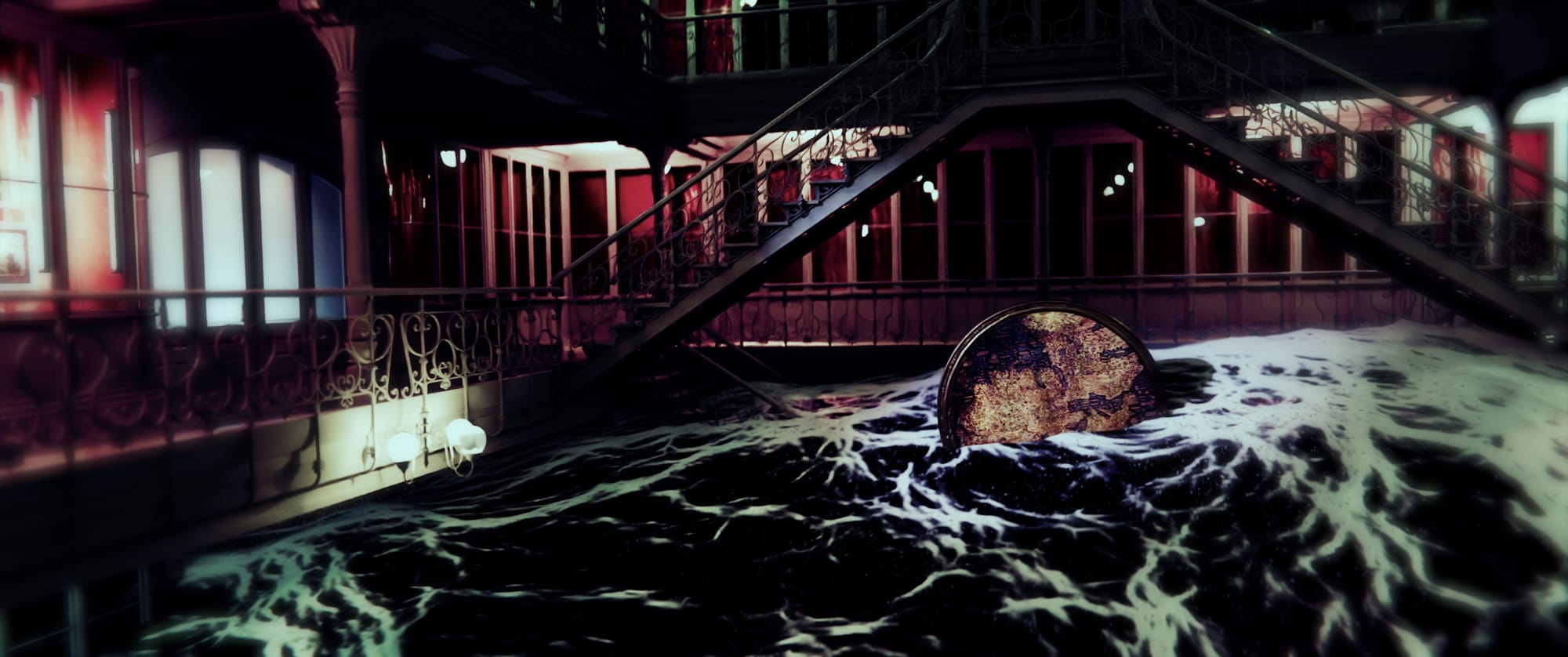
The Lisbon Geographic Society appears as a low-resolution virtual interior, constantly in danger of flooding. Its large circular map remains at the center of the space, while the building resembles a capsizing old ship. What did this unstable digital rendering make possible in your treatment of the Society and its history as a producer of colonial geographical knowledge?
I did not want to reconstruct the Society as a seamless or authoritative heritage space. A highly detailed photorealistic reconstruction would have repeated something of the institution’s own flawed foundational logic —that a territory or history can be surveyed, reproduced and made completely available to the viewer.
For me the low-resolution reconstruction allowed the building to remain incomplete. It is recognizably the Lisbon Geographical Society, but it is also unstable and visibly artificial.
I began thinking of the building as a vessel carrying the remains of a particular geographical imagination and the metaphor I worked with was a ship that is taking on water and gradually capsizing.
The flooding was important because the sea had historically been contained inside this institution through maps and colonial narratives while in the virtual space, the sea enters the building itself. The space that attempted to organize and control maritime geography becomes vulnerable to it.
Shahram Khosravi is projected delivering a lecture on imperialism, geographical knowledge as a form of power, and border crossings at the rendered Lisbon Geographic Society, an institution linked to colonial planning and the control of trade. The scene places an account of informal movement within a space historically devoted to rendering territory, labor, and circulation legible to empire. How did you think through that staging, and what relation did you want the lecture to establish with the Society’s history and its virtual, low-poly reconstruction?
I wanted Shahram’s lecture to enter the Society as a different form of geographical knowledge, or perhaps a counter-geographical voice. The institution historically produced geography through expeditions that made distant borders and populations legible to state power. Shahram’s work often begins from the other side of that process, from the person who crosses a border and produces knowledge through movement rather than through territorial overview.
Placing the lecture inside the Society created a confrontation between these two ways of seeing. One looks down from the map and asks how movement can be organized and controlled. The other begins from the body attempting to move and asks how borders are negotiated.
But I did not want the staging to become a simple replacement either. His presence is somewhat ghostly and digitally mediated through noise interferences. He is speaking inside the Society, but he does not fully occupy or possess it.
For me, the scenes with Shahram are less about placing the correct politics inside the wrong institution and more about making two geographical positions encounter one another.
The film follows informal trade as a means of sustaining movement and livelihood under sanctions, border restrictions, and unequal access to legal mobility. It also stays close to the danger, surveillance, dependency, and unequal power that shape these networks. How did you approach this ambivalence, especially the coexistence of resourcefulness and exposure, without reducing informal trade either to criminality or to a straightforward form of resistance?
I never encountered the informal economy as something completely outside the state. The formal and informal systems were always entangled. Informal trade depends on state infrastructure and personal relationships inside institutions.
So I did not want to present the network as an anarchic space beyond the confines of power relations. Smuggling in the Persian Gulf creates possibilities for people whose legal mobility has been restricted by sanctions, borders, nationality, or class, but it also has its own hierarchies.
At the same time, describing everything through criminality would simply repeat the categories of the state. It would make the legal framework appear neutral and coherent, when many of these networks exist precisely because official systems make ordinary forms of movement and livelihood impossible.
I think resourcefulness and vulnerability coexist. They are not opposites. Often, resourcefulness is the way people survive exposure to protracted risk. I tried to remain close to the intelligence of the network without romanticizing it. I did not want to create heroic smugglers standing outside the state, but I also did not want to reduce people to victims. The film asks what these systems enable, which actors benefit from them, and who is left most exposed when failure or collapse occurs.
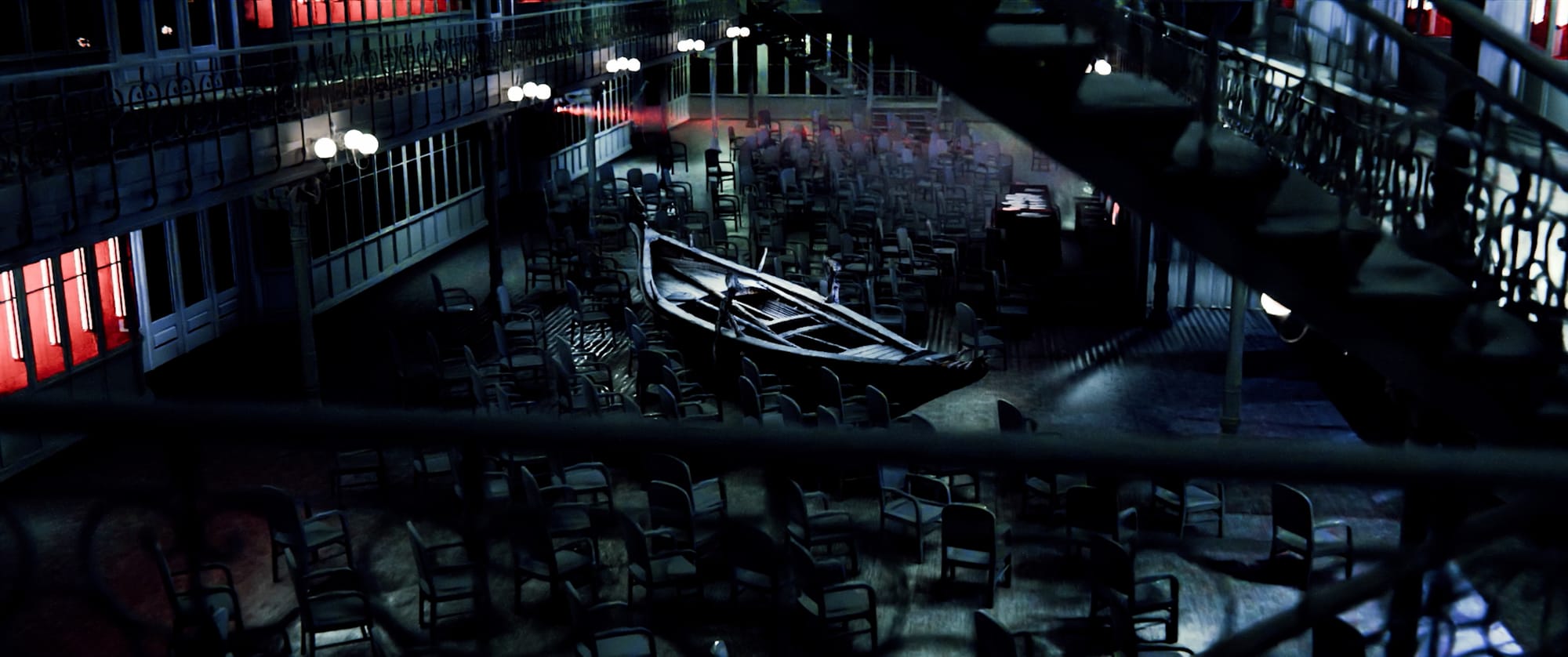
The film brings together forms and registers that seem to pull the viewer in different directions at the same time, such as the operatic voice inside the viscous, sinking 3D environment of the Lisbon Geographic Society or slow-motion speedboats accompanied by what sounds to me like techno-dabke. How did you think through these collisions? What kind of experience of the Strait did you want this shifting and clashing between styles, sounds, and image textures to produce?
The Strait was already a collision of very different visual and political realities. It is a military chokepoint, a tourist landscape, a workplace, an inherited route, a space of imperial fantasy, and a site of everyday life for many. It did not make sense to give all of this a single, coherent visual language.
The collisions between forms were my way of resisting that coherence. The operatic voice brings a kind of grandeur into a digital environment that is visibly unstable and sinking. Many of the musical choices and testimonial elements of the film’s narration, which were later re-enacted from my fieldnotes, actually came from sharing music and stories with sailors and port stevedores. The Kurdish techno-dabke song, for instance, was one of my interlocutor’s favorite songs to speed to while aboard the speedboat.
I was interested in the moment when an image becomes seductive and then slightly uncomfortable. The slow-motion boats can look powerful or beautiful, but the viewer also knows that they are carrying people, animals, debt, and risk. I did not want to pretend that documentary images cannot be visually compelling. The question was how to make that attraction unstable.
You have described the narration as a conversation between Benjamin’s landed tiller and seafaring trader as a propeller, with the latter becoming a transhistorical sea entity. The film gives that figure a visible form in the turning propeller at the ceiling of the Society, while its presence on the shooting boats remains mostly inferred through their movement. The images also move between two distinct registers: a patient, descriptive attention to labor, infrastructure, and landscape; and more abstract, layered, emotive passages, where images and textures accumulate and the camera seems to leave stable perspective behind. How did the two narrative voices shape this movement between visual registers?
I thought of the landed tiller and the seafaring trader less as two conventional characters and more as two positions from which the story can be told.
The landed voice learns through staying in one place and observing its changes. It is connected to the more patient parts of the film, where the camera remains with a landscape or the port, long enough for its labor and organization to become legible.
The seafaring voice on the other hand can move across centuries and archival fragments without following a completely linear path. It becomes less human as the film develops and more like a force moving through the sea. This is why in my mind, the propeller became its physical manifestation.
The more abstract passages are connected to that seafaring position. In the churn of the propeller, spatial orientation becomes uncertain, and the film moves between observation and testimony without fully explaining the transitions.
In an early passage, the film moves from darkness into daylight as boats cross and arrive. This shift registers the practical timing of the trade, while the narration places the crossings within a practice inherited across generations. How did you work with light, color, and editing to hold together the immediate pressure of a particular crossing and this longer history?
Light in Khasab was not only an aesthetic condition. It was part of how the route was regulated and organized. The movement of boats depended on visibility, port hours, patrol schedules and the narrow openings during which arrival was possible. Darkness could offer protection, while daylight could mean both safety and exposure. The movement from night into blue morning therefore follows the practical conditions of a particular crossing. The boats are working with a very specific window of time.
At the same time, the narration speaks about this knowledge about circadian rhythms as something that has been carried through generations. I wanted to emphasize that what is inherited along this route by its multi-generational users is a collection of skills, memories and ways of responding to uncertainty that go way beyond the immediate material conditions of moving cargo for trade.
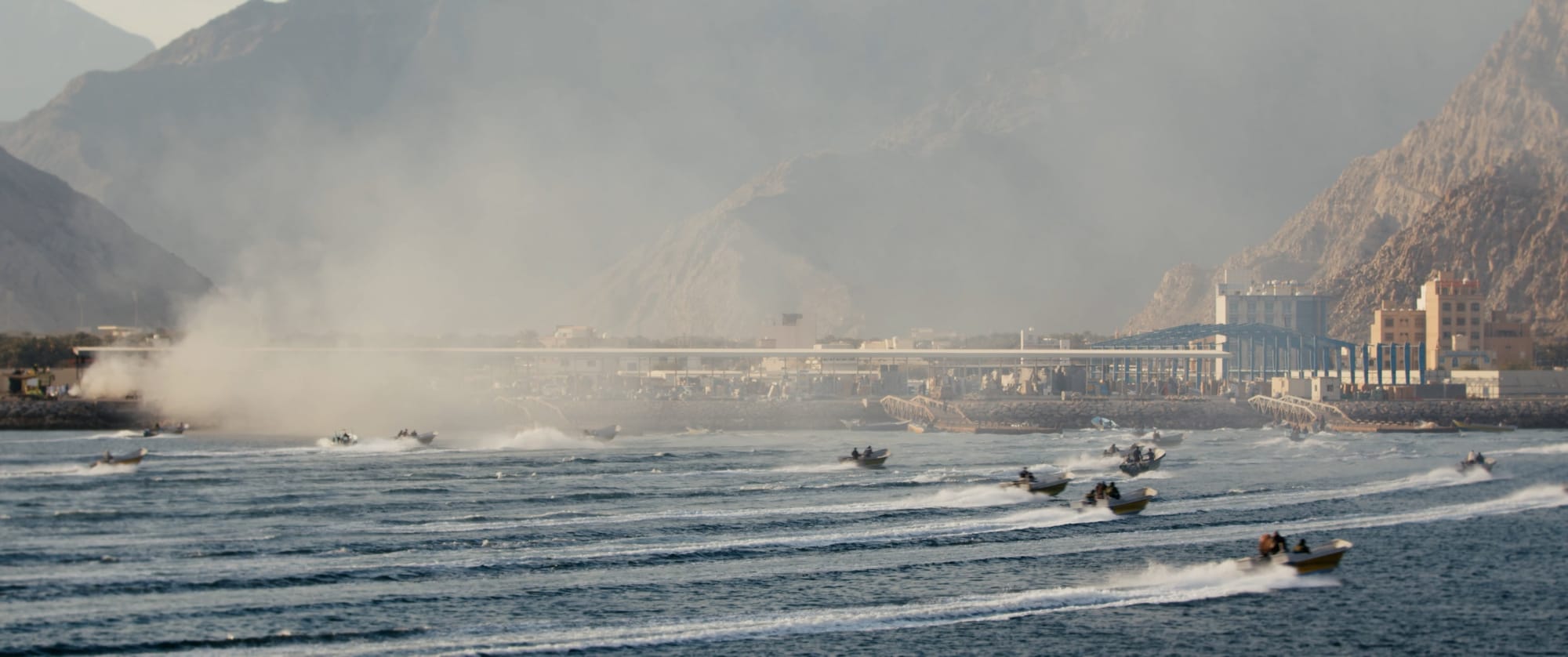
The crossings have a complex, dangerous choreography: bodies, sheep, cargo, speedboats, and papers move and are created in complicated patterns. At the same time, the film shows infrastructure, enforcement, technology, and rules continually changing the conditions of that movement. How much of this do you see as learned and passed through generations, and how much has to be reinvented with each route, crossing, or shift in enforcement?
A great deal of the knowledge is inherited, but I do not think what is inherited is unchanging. What is passed down is more like the capacity to innovate and reroute.
There is embodied knowledge about how to read the sea, distribute weight on a boat, load animals, maintain engines, assess weather or moor at a port, but there is also commercial and social knowledge around how credit works, who can guarantee a safe passage and at what cost, and most importantly how a problem in one place may affect another part of the network.
Since social, political and economic conditions change constantly, especially nowadays due to the terrible war that is unfolding, routes that worked perfectly for several months may no longer be possible. So every crossing contains a tension between repetition and invention and people and their ingenuity kind of turns them into the very infrastructures that allow these routes to continue to function.
To put it shortly, tradition here does not mean doing the same thing forever. It means transmitting forward a practice of adaptation.
The film repeatedly works through forms that have historically made territory, labor, and movement visible to power, such as the colonial map in the Society, the tourist gaze from the cruise ship, documentary and ethnographic distance, surveillance, and administrative documentation. The camera often keeps the landscape, its infrastructure, and the people at a distance, while slow motion gives the speedboats an intensified visual presence. How did you think through the relation between these inherited visual forms and the film’s own ways of looking? What tensions or limits emerged when dangerous, clandestine work also became visually compelling?
Of course, this film cannot stand completely outside the visual traditions it is examining. I was very conscious of this, especially while filming the boats. From far away, a speedboat can become an abstract movement against the horizon. Depending on who is looking, the same boat might be understood as a threat, a target, evidence of criminal activity, a source of livelihood or simply a beautiful image.
In this specific case, distance has an ethical function. It helps protect identities and prevents the film from extracting faces or personal testimonies as proof. It also allows the boats, bodies, animals, and infrastructure to appear as parts of a larger system. Of course, that does not remove the historical meanings of the distant view but my intention with this film was to unpack the image with its highly critical contextualization and narration.
Slow motion created a similar tension. The boats usually pass so quickly that they become almost invisible. Slowing them down gave the movement duration and allowed the viewer to notice the number of animals and the instability of the boat. Although this style of filming intensifies the image and makes it seductive, I do not think this contradiction could be resolved by making the film deliberately under-produced and cinematically unappealing.
Instead of claiming that my camera is neutral, I try to work with the tension so the viewer may feel the attraction of the image but also become aware of the position from which they are looking.
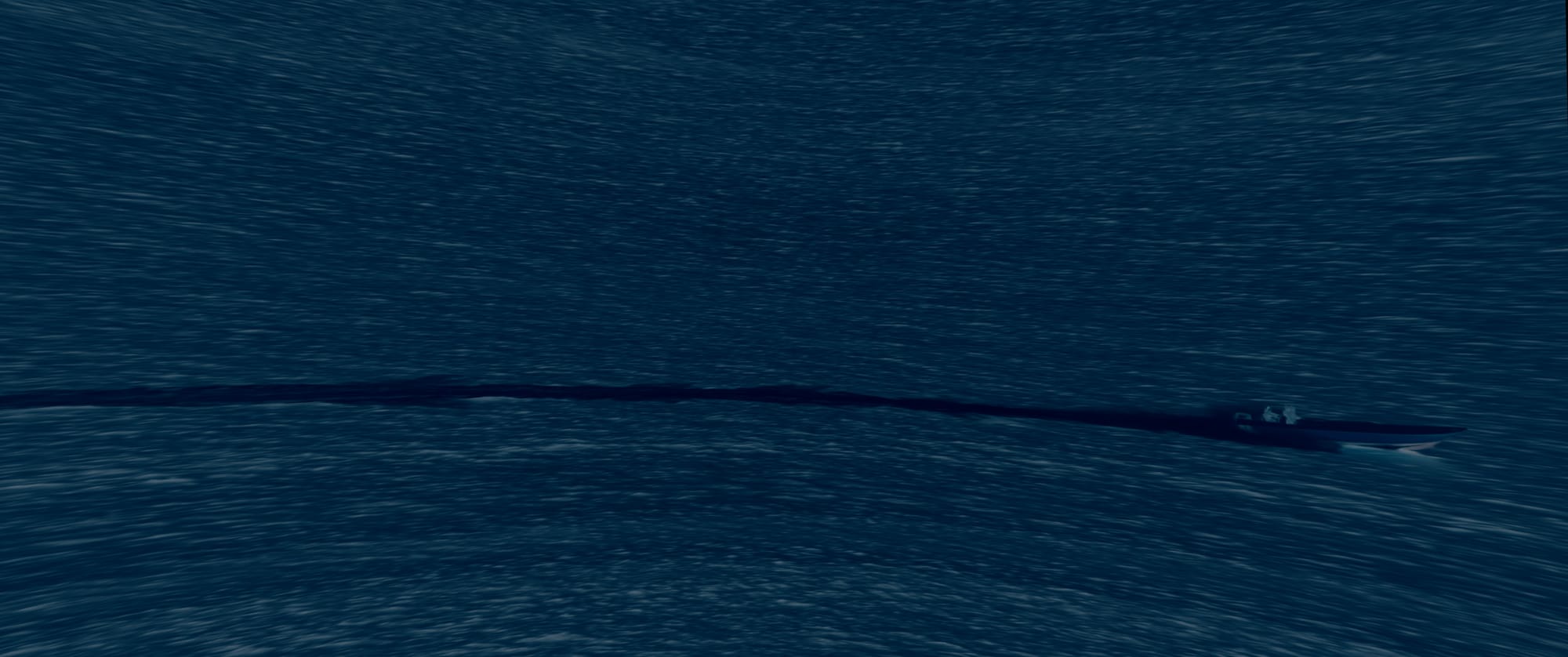
Early on, the narrator says that “the fiction of paperwork races to meet the fact of arrival.” The phrase stays with the film because documentation, timing, movement, and legality are constantly out of sync. How did you approach editing this relation between paperwork and arrival, between the categories through which movement is administered and the practical work of getting across and making a livelihood?
The phrase came from observing a kind of temporal reversal. We usually imagine that documentation comes first, that permission is granted, the cargo is classified, the origin is established and then movement takes place. But in many of the situations I was following, the movement already had its own urgency. The animals had to arrive and the arrival documents had to catch up.
In the editing, I did not want documents to function only as explanatory inserts. I wanted the film to maintain the mismatch between the physical reality of movement and the categories used to describe it, both in the present time and historical archives.
The film begins and ends with similar blue images of the landscape. Across its different sites and registers, it brings past routes, inherited practices, archival histories, and present-day crossings into contact, while the propeller, which you describe as churning within history, remains a figure of constant motion, possibly without end. At the beginning, the narrator also states there being no beginnings or ends. How did you think about the film’s return to its beginning? What did circularity allow you to do with the relation between movement, labor, power, and changing infrastructure?
For me, circularity became a way of thinking about the continuity of passage. Borders become more fortified, ports are erected, new surveillance technologies appear and particular routes become blockaded. But passage never simply stops. It is redirected or reorganized through another relationship or another opening.
This is also why the propeller became such an important figure for me. It moves with a circular motion, clearly repeating the same pattern all the time, but that repetition produces forward movement. For me this circularity does not mean that history repeats itself without change. It actually is the force that allows continuity and transformation to co-exist together.
From a narrative stand-point this return to the beginning also prevents the film from treating any single barrier, catastrophe or geo-political event as a conclusive chapter. I’m trying to suggest that the film and its narrative stops, but the movements and routes it is mingling with won’t. There is always another attempt to make the crossing possible.